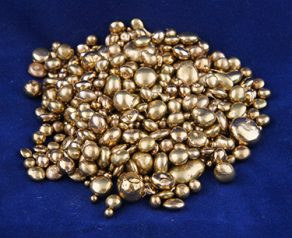
Navy G Bronze Alloy UNS C90300 is a copper-tin-zinc casting alloy with a nominal composition of 88% Cu, 4% Zn, and 8% Sn, conforming to CDA number 90300. The high tin content provides excellent strength, hardness, and corrosion resistance in steam and water environments, while the zinc addition improves castability and reduces cost compared to tin bronzes without zinc. The lead-free composition makes it suitable for applications requiring good corrosion resistance without the machinability benefit of lead additions.
C90300 is specified for steam pressure applications involving temperatures up to 550°F (288°C), including steam valves, pump bodies, impellers, and pressure fittings in marine and industrial environments. Its excellent resistance to seawater corrosion, dealloying, and erosion makes it a standard specification for naval and marine hardware. The alloy also performs reliably in fresh water systems, chemical processing equipment, and general engineering applications requiring pressure containment at elevated temperatures.
Supplied in 1–20 lb ingots to accommodate both small precision casting operations and larger production furnace requirements.
Common technical inquiries regarding Navy G Bronze Alloy UNS C90300
Above 550°F (288°C), the tin-zinc intermetallic phases in C90300 begin to soften and lose creep resistance, reducing the alloy's ability to maintain pressure containment under sustained load. The 550°F limit is recognized by ASTM B61 and B62 and ASME pressure vessel codes for steam bronze components. For steam service above 550°F, nickel-aluminum bronzes, duplex stainless steels, or high-temperature copper-nickel alloys are the appropriate alternatives depending on pressure, corrosion environment, and cost requirements.
C90300 (Navy G) has higher tin (8% vs 6%) and no lead (vs 1.5% in C92200), giving it better corrosion resistance and strength but reduced machinability compared to Navy M. Navy G is the correct specification for structural and pressure-containing components in seawater systems where lead-free construction and maximum corrosion resistance are the priorities. Navy M (C92200) is chosen when machinability is important — such as for machined fittings and valves — and the slightly lower tin content and small lead addition are acceptable for the corrosion environment.
C90300's moderate freezing range requires careful gating and risering to achieve directional solidification toward the riser and prevent mid-section shrinkage porosity in pressure-critical walls. Melt degassing with nitrogen or argon before pouring is recommended to minimize hydrogen porosity — a particular risk in tin bronze melts at operating temperatures. Pouring temperature should be controlled at 150–200°F above the liquidus (typically 1,950–2,050°F) to ensure complete fill without excessive turbulence. Pressure testing at 1.5× design pressure after machining is standard practice for steam service castings.
To provide the best experiences, we use technologies like cookies to store and/or access device information. Consenting to these technologies will allow us to process data such as browsing behavior or unique IDs on this site. Not consenting or withdrawing consent, may adversely affect certain features and functions.
Functional
Always active
The technical storage or access is strictly necessary for the legitimate purpose of enabling the use of a specific service explicitly requested by the subscriber or user, or for the sole purpose of carrying out the transmission of a communication over an electronic communications network.
Preferences
The technical storage or access is necessary for the legitimate purpose of storing preferences that are not requested by the subscriber or user.
Statistics
The technical storage or access that is used exclusively for statistical purposes.The technical storage or access that is used exclusively for anonymous statistical purposes. Without a subpoena, voluntary compliance on the part of your Internet Service Provider, or additional records from a third party, information stored or retrieved for this purpose alone cannot usually be used to identify you.
Marketing
The technical storage or access is required to create user profiles to send advertising, or to track the user on a website or across several websites for similar marketing purposes.