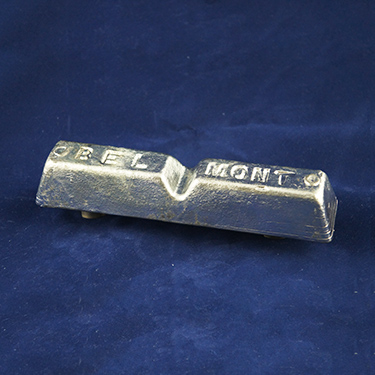
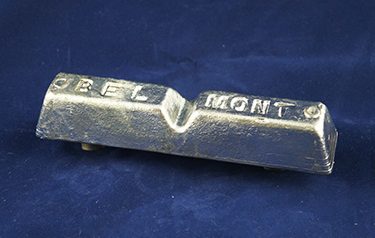
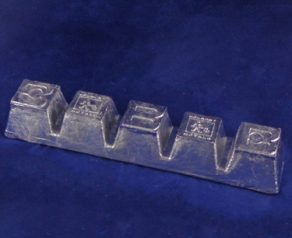
6% Antimonial Lead is a lead-antimony-tin alloy with a nominal composition of 93% Pb, 6% Sb, and 1% Sn. Lead-antimony alloys form a more protective and impermeable surface oxide film than pure lead improving corrosion resistance in most industrial environments — particularly in the presence of sulfuric acid and other industrial chemicals where antimonial lead outperforms both pure soft lead and most alternative metals. The 6% antimony content is the most widely used target shooter and hunter formulation balancing hardness (approximately 16-18 HB), castability, and moderate cost. The 1% tin addition improves fluidity and mold fill. Forms: 2-8 lb ingots, rods, and sheet for a range of casting and fabrication applications.
Available Forms
2-8 Ingot, Rods, Sheet
Product Code
5933
Technical Info
Thermal Properties
Melting Point (Solidus)473°F (245°C)
Melting Point (Liquidus)545°F (285°C)
Physical Properties
Density (imperial)0.39 lbs/in³
Density (metric)10.82 g/cm³
Primary ElementsPb · Sb · Sn
Lead FreeNo — contains lead
Key Features
6% Sb Most Popular Shooter AlloySuperior Corrosion Resistance to Soft LeadIngot Rod and Sheet FormsIndustrial Lining Grade
Nominal Composition
93% Pb
6% Sb
1% Sn
Frequently Asked Questions
Common technical inquiries regarding 6% Antimonial Lead
6% Sb antimonial lead achieves approximately 16-18 HB in the as-cast condition — approximately 3-4 times harder than soft lead but softer than linotype (22-24 HB). This intermediate hardness provides enough anti-leading performance for typical cast bullet applications (pistol and low-velocity rifle bullets at velocities under 1500 fps) while remaining soft enough to obturate (seal) the bore under gas pressure. Linotype at 22 HB can be too hard to obturate in some applications leading to gas leakage and accuracy loss. The 6% Sb alloy represents the practical optimum for general-purpose cast bullet applications.
6% antimonial lead is used for chemical plant storage tank linings, pipe and fittings for sulfuric acid service, battery grid alloys, and roofing and flashing where improved corrosion resistance versus soft lead is required. Antimony improves corrosion resistance by refining the lead grain structure and modifying the composition of the surface oxide film producing a denser more adherent and less permeable protective layer. In sulfuric acid environments specifically the PbSO4 film formed on antimonial lead is more stable and protective than on pure lead extending service life by 20-40% in comparable service.
The 2-8 lb ingot is the foundry casting form for melting and pouring into molds for bullet casting, jig production, and general gravity casting. Rods are used for lead burning (lead welding) to fabricate and repair chemical plant lead linings — the rod is melted with a hydrogen or oxyacetylene torch to build up welds and seal joints in sheet lead assemblies. Sheet form is used for roofing, flashing, radiation shielding panels, and chemical plant lining applications where the alloy is cut, formed, and mechanically fastened or lead-burned to substrate structures. Sheet antimonial lead maintains better dimensional stability during thermal cycling than pure soft lead sheet.
99.9% Pb lead in sectional ingot shot pig bar powder sheet and wool forms for batteries radiation shielding counterweights and general lead applications.