
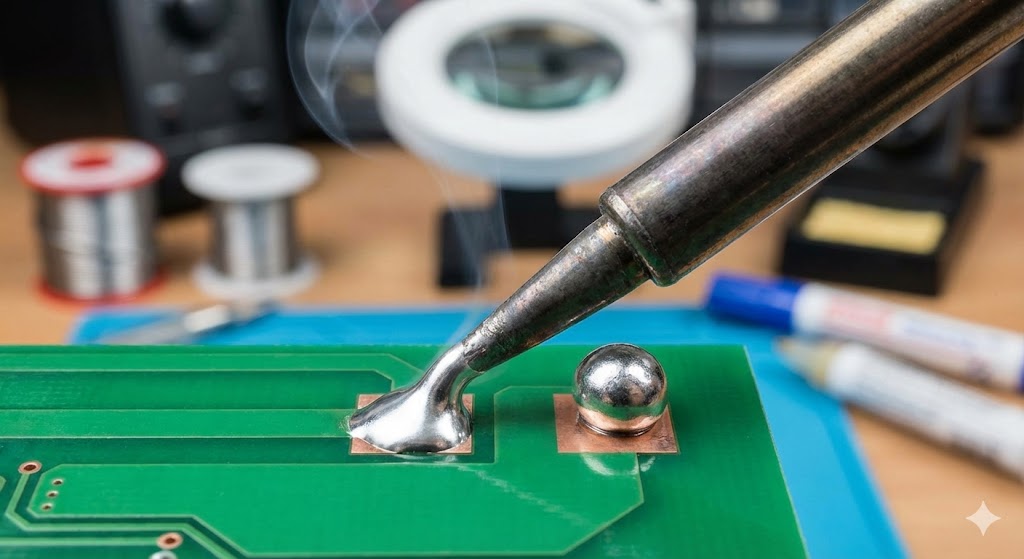
A “cold joint.” A “dewetted” pad. A bond that snaps under the slightest vibration. In the world of industrial soldering and electronics manufacturing, these failures are often immediately blamed on operator error—”The iron wasn’t hot enough” or “The technician moved the part.”
But after analyzing thousands of failed joints in our lab, the team at Belmont Metals knows that more often than not, the root cause is a fundamental mismatch between the base metal, the solder alloy, and the flux.
The key to a strong, hermetic joint isn’t just heat; it is Wettability.
Defining the Bond: It’s Not Glue
Many fabricators think of solder as a “hot glue” that sticks two metals together. This is a dangerous misconception. Soldering is a chemical reaction. For a joint to hold, the molten solder must dissolve a microscopic layer of the base metal to form an Intermetallic Compound (IMC).
If the solder “balls up” and rolls off the surface (poor wetting), that chemical reaction never happened. You have a mechanical obstruction, not a metallurgical bond.
The Oxide Barrier: Soldering the “Un-Solderable”
Standard Tin-Lead or SAC (Sn-Ag-Cu) solders combined with rosin fluxes work wonders on copper and brass because those metals are easily cleaned. But what happens when you need to join stainless steel, aluminum, or oxidized nickel?
- The Problem: These metals are designed to resist corrosion by forming tough, passive oxide layers instantly upon exposure to air. Standard rosin flux is too weak to break through this barrier.
- The Solution: You generally have two paths.
- Aggressive Fluxing: You may need an acid-based flux capable of stripping the chrome-oxide layer on stainless steel.
- Specialty Alloys: For truly difficult materials like glass, ceramics, or heavily oxidized metals, Indium-based solders are the industry secret. Indium has a unique ability to wet non-metallic surfaces that ordinary tin alloys simply slide off of.
The Lead-Free Heat Wave
The global shift to RoHS-compliant (Lead-Free) soldering has introduced a new challenge: Thermal Stress. Standard lead-free alloys like SAC305 melt at roughly 217°C, significantly higher than the 183°C of traditional Tin-Lead.
- The Risk: These higher processing temperatures can warp printed circuit boards (PCBs), damage heat-sensitive components like LEDs or sensors, and cause “tombstoning” of small chips.
- The Low-Temp Alternative: If your components can’t take the heat, you don’t have to go back to lead. We offer Low-Temperature Lead-Free Alloys, typically blends of Bismuth and Tin, which melt as low as 138°C. These are game-changers for “step soldering” processes, where you need to solder a secondary component without re-melting the primary joints you just finished.
From Radiators to Microchips
Whether you are using 50/50 bar solder for industrial radiator repair or ultra-pure wire for semiconductor packaging, the principle remains the same: The alloy must match the application.
Stop fighting the physics of the metal. If you are struggling with a joint that just won’t stick, send us the specs of your base materials and your operating temperature limits. Our metallurgical team will recommend the specific alloy and flux combination that ensures a perfect, continuous bond every time.