
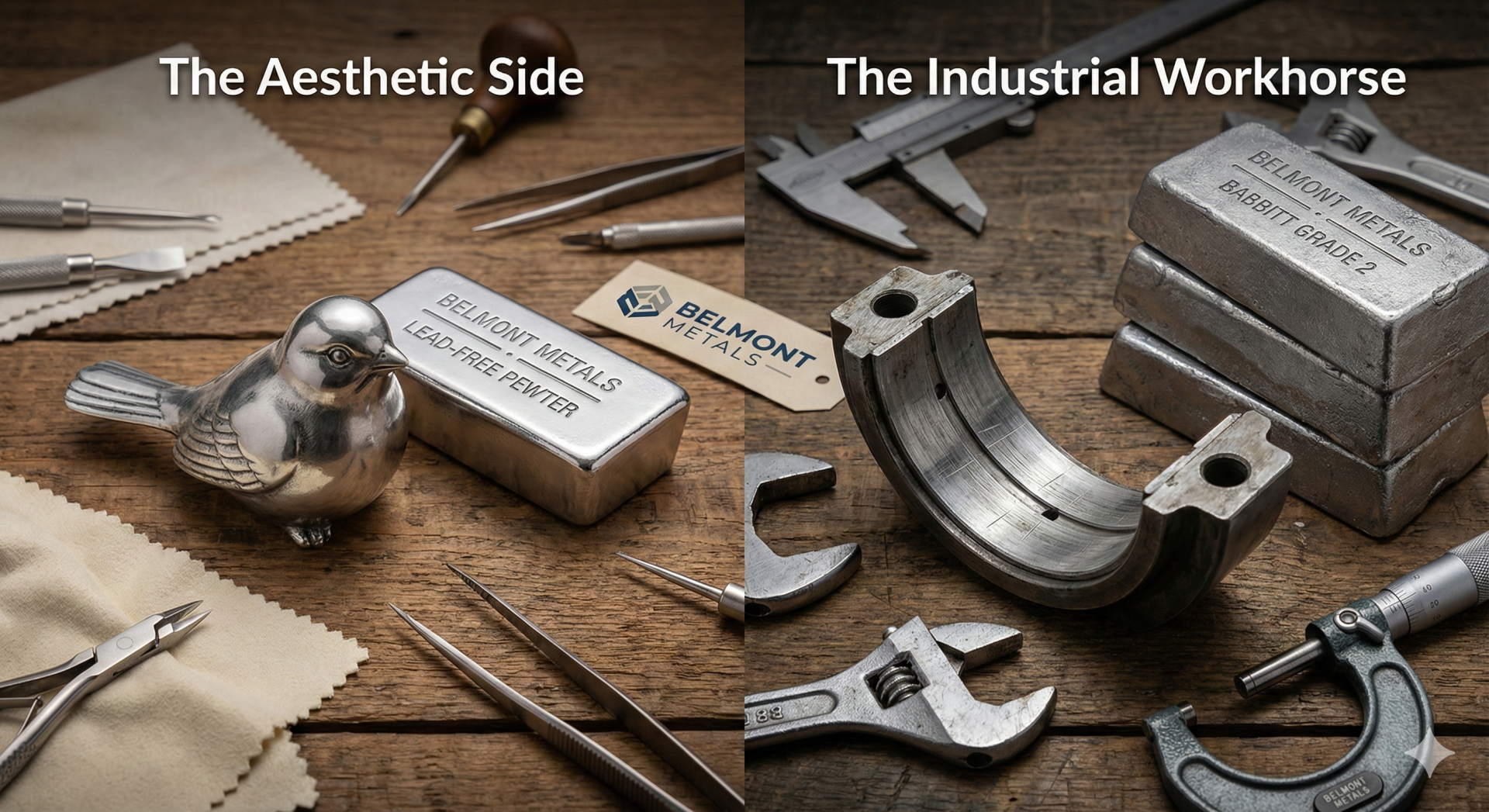
When people think of tin, their minds often go to simple plating or tin cans. Yet, in the world of non-ferrous metallurgy, tin is the versatile foundation for a crucial family of materials known collectively as “White Metals.”
These alloys are defined by their relatively low melting points, bright silvery appearance, and remarkable range of applications. For over a century, Belmont Metals has been refining the art of the tin base, providing materials that serve both the most delicate artistic requirements and the most grueling industrial demands.
This month, we are exploring the two distinct sides of the tin tradition: the aesthetic beauty of Pewter and the mechanical necessity of Babbitt.
The Aesthetic Side: Lead-Free Pewter
For centuries, pewter was the standard for household tableware. Today, it has experienced a renaissance among artisans, jewelry designers, and sculptors. The key to modern pewter lies in safety and workability.
Belmont Metals is a premier supplier of Lead-Free Pewter alloys. By replacing lead with elements like antimony and copper, we provide a material that is safe for consumer goods while retaining the characteristics designers love. Our pewter alloys offer excellent fluidity for detailed casting, a bright surface finish that polishes beautifully, and a pleasing weight that speaks to quality in finished jewelry and decorative objet d’art.
The Industrial Workhorse: Babbitt Metals
On the other end of the spectrum lies one of the most critical, yet hidden, applications of tin: the bearing.
In heavy machinery—from marine engines to industrial turbines—a steel shaft rotating at high speed needs a forgiving surface to ride against. If steel rubs against steel, friction spells disaster.
Enter Babbitt Metal, a tin-based “white metal” alloy invented in 1839. Belmont supplies high-grade Babbitt alloys designed to act as a sacrificial surface. The genius of Babbitt lies in its dual nature: hard crystals within a soft matrix.
-
Conformability: The soft matrix allows the bearing surface to adjust to slight misalignments in the shaft.
-
Embeddability: The alloy can absorb small foreign particles (like dirt or metal shavings), preventing them from scoring the expensive steel shaft.
When the world’s heavy machinery keeps moving, it is often sliding on a thin layer of Belmont tin alloy.
Purity and Form in Every Melt
Whether you need Britannia metal for precise casting or a specific grade of Babbitt for turbine maintenance, purity is paramount. Contaminants in tin alloys can ruin a jewelry casting’s finish or cause catastrophic bearing failure.
At Belmont Metals, we ensure strict quality control across our entire tin range. We offer these alloys in forms tailored to your process, including ingots, notched bars, wire, and shot.
From the workshop to the engine room, rely on the tin tradition established at Belmont since 1896.