
If you’ve been tracking the commodities market, you know the story: the Silver market is seeing unprecedented volatility, with prices trending upward due to surging industrial demand in photovoltaics, EVs, and AI hardware. While this is great news for investors, it poses a distinct challenge for us in the manufacturing and engineering sectors. At Belmont…
|
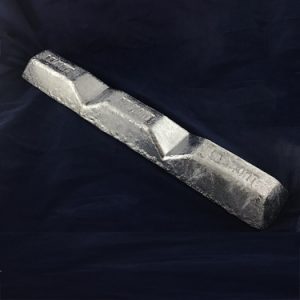
711.1 is a high-strength aluminum-zinc casting alloy that achieves excellent mechanical properties through natural aging, eliminating the need for costly and time-consuming heat treatment cycles. Renowned for its superior dimensional stability and brazability, it is an ideal material for complex structural components that require precise tolerances without warping. By utilizing zinc as its primary strengthener, this alloy provides a unique combination of high impact resistance and good corrosion protection. Supplied in 3-16 lb. ingot form, it is widely used in applications where post-casting stability is critical. |
|
| Forms: |
|
|---|---|
| Belmont Product Code | 1940 |
| Nominal Composition: |
|
|---|
| Technical Info: |
|
|---|
Downloads:
| SDS |
Related products
-

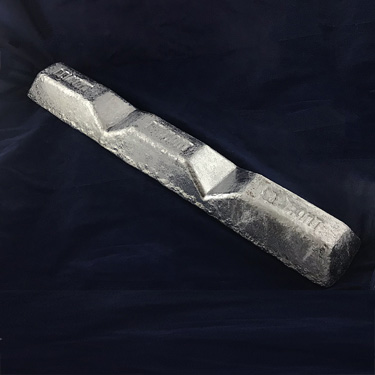
A201.1 is a premium Aluminum-Copper-Silver alloy belonging to the 200-series, renowned for delivering ultra-high tensile strength—nearly double that of common 300-series aluminum-silicon alloys. Designed for applications where the strength-to-weight ratio is the absolute priority, it is a standard specification in the aerospace and transportation sectors. While it possesses a wide freezing range that makes it more challenging to cast than standard alloys, its mechanical performance is unmatched for structural components requiring high fracture toughness. Available in ingot, sheared pieces, and waffle forms to suit various melting operations.
Forms: - Ingot
- Sheared Pieces
- 16-17 Waffle
Belmont Product Code 19413 Nominal Composition: - 94% Al
- 4.5% Cu
- 0.7% Ag
- Bal
Technical Info: - Melting Point (Liquidus): ~1,205°F (652°C)
- Melting Point (Solidus): ~1,005°F (540°C)
- Density: ~0.101 lbs/in³ (2.80 g/cm³)
- Features: Ultra-High Strength, Heat Treatable
-
852.1 is a specialized Aluminum-Tin-Copper-Nickel alloy designed primarily for high-performance bearing and bushing applications. The inclusion of 6% Tin provides excellent natural lubricity and seizure resistance, while Copper and Nickel additions significantly enhance yield strength and hardness. This alloy is an ideal lightweight alternative to traditional bearing bronzes, capable of withstanding high speeds and heavy loads in hydraulic and automotive components. Supplied in ingot form, it offers excellent machinability and wear resistance for precision casting operations.
Forms: - 3-16 Ingot
Belmont Product Code 18912 Nominal Composition: - 90% Al
- 2% Cu
- 0.8% Mg
- 1.2% Ni
- 6% Sn
Technical Info: - Melting Point (Liquidus): ~1,190°F (643°C)
- Melting Point (Solidus): ~445°F (229°C)
- Density: ~0.103 lbs/in³ (2.85 g/cm³)
- Features: Excellent Bearing Properties, High Wear Resistance
-
A356.2 is the industry standard for high-strength, pressure-tight aluminum castings, offering excellent castability and machining characteristics. This Aluminum-Silicon-Magnesium alloy is heat-treatable (typically to T6) and provides superior corrosion resistance and weldability compared to other casting alloys. It is the primary choice for intricate, complex parts such as aircraft components, pump housings, impellers, and high-velocity blowers where lightweight structural integrity is critical. Available in standard ingot and saw-cut pieces to suit various foundry melting requirements.
Forms: - Ingot
- Saw Cut Pcs.
Belmont Product Code 10A356P Nominal Composition: - 92.6% Al
- 7% Si
- 0.4% Mg
Technical Info: - Melting Point (Liquidus): ~1,135°F (613°C)
- Melting Point (Solidus): ~1,035°F (557°C)
- Density: ~0.097 lbs/in³ (2.67 g/cm³)
- Features: Pressure Tight, Heat Treatable
RELATED POSTS

Discover A201.1 Alloy: High-Strength Solutions from Belmont Metals
At Belmont Metals, we’re passionate about providing premium metals and alloys that meet the rigorous demands of metal buyers and engineers. As a leader in the industry, we’re excited to highlight A201.1 alloy, a high-performance aluminum-copper-silver alloy renowned for its exceptional properties. Whether you’re sourcing materials for aerospace components or industrial castings, A201.1 alloy offers…
Unlocking Scalmalloy: Properties and Additive Manufacturing Applications at Belmont Metals
At Belmont Metals, we’re dedicated to delivering cutting-edge metals and alloys that empower metal buyers and engineers like you to innovate. Today, we’re thrilled to spotlight Scalmalloy, a groundbreaking aluminum-magnesium-scandium alloy that’s revolutionizing additive manufacturing. With its superior Scalmalloy properties, this high-performance material is ideal for demanding applications across industries. Whether you’re exploring Scalmalloy for…
Strong and Ductile: Magnesium Added to Aluminum Alloys Provides Amazing Benefits
When we think about aluminum, we most often associate this metal to the flexible foil used for everyday cooking. Yet this alloy can be used in applications where strength, corrosion resistance and weldability are required. The construction industry often uses aluminum alloys as beams, metal sheathing, and as scaffolding. This metal can also be used…
Magnesium Elements: Providing Positive Benefits to Copper and Aluminum Alloys
Alloys on their own can offer a range of mechanical and structural benefits for manufacturers and other industries. Yet your application may require the alloy to have increased strength, workability, or ductility for the particular application. Magnesium is one of many chemical elements that becomes added to other alloys such as copper and aluminum to…
Silicon: Increasing the Properties of Aluminum and Copper Alloys
Copper and aluminum are used in a range of applications around the world. You can find aluminum as beverage cans, metal building sheets and storage tanks. Copper is often found in environments that are electrically conducive, as you may see it as wiring. You can also find copper in electronics and used as brass or…
Cold Working Aluminum Alloys
When considering working and manufacturing with metals, particularly with aluminum, the first thoughts are centered on the heating process with hot furnaces where the metal is heated to extremely high temperatures and then wrought or cast into form. However, there is another type of process to strengthen the metal that involves adding other alloys to…
Grain Refinement of Aluminium Alloys
Look around you. You live in a world that contains raw materials that are formed and produced into the products you use and the homes you live in. One of the most widely available metals in the world is aluminum. It is the second most abundant element in the environment as we use it in…
Custom creations
Aluminum master alloys help metallurgists fine-tune alloys to create materials that are stronger, lighter, and more easily processed Aluminum is the most abundant metallic element in the Earth’s crust—it’s even more common than Iron. In its pure form, though, it’s soft and malleable. It needs to be alloyed with other elements, including Iron, Zinc, Silicon,…
Solid structures
From everyday uses to extreme applications, Aluminum alloys get the job done Many people think of Aluminum in terms of crushable cans and foil, but, in addition to being lightweight, Aluminum’s strength and toughness is valuable when manufacturing cars, trucks and military vehicles. There are more than 500 recorded alloys that contain Aluminum, and because…
Light and strong
Aluminum alloys are essential to a wide variety of applications From planes to trains, cans and cars—when engineers are looking for a way to reduce weight but retain strength, they often turn to lightweight, durable Aluminum. The white metal only has been manufactured in commercial quantities for just over a century, largely due to the…