
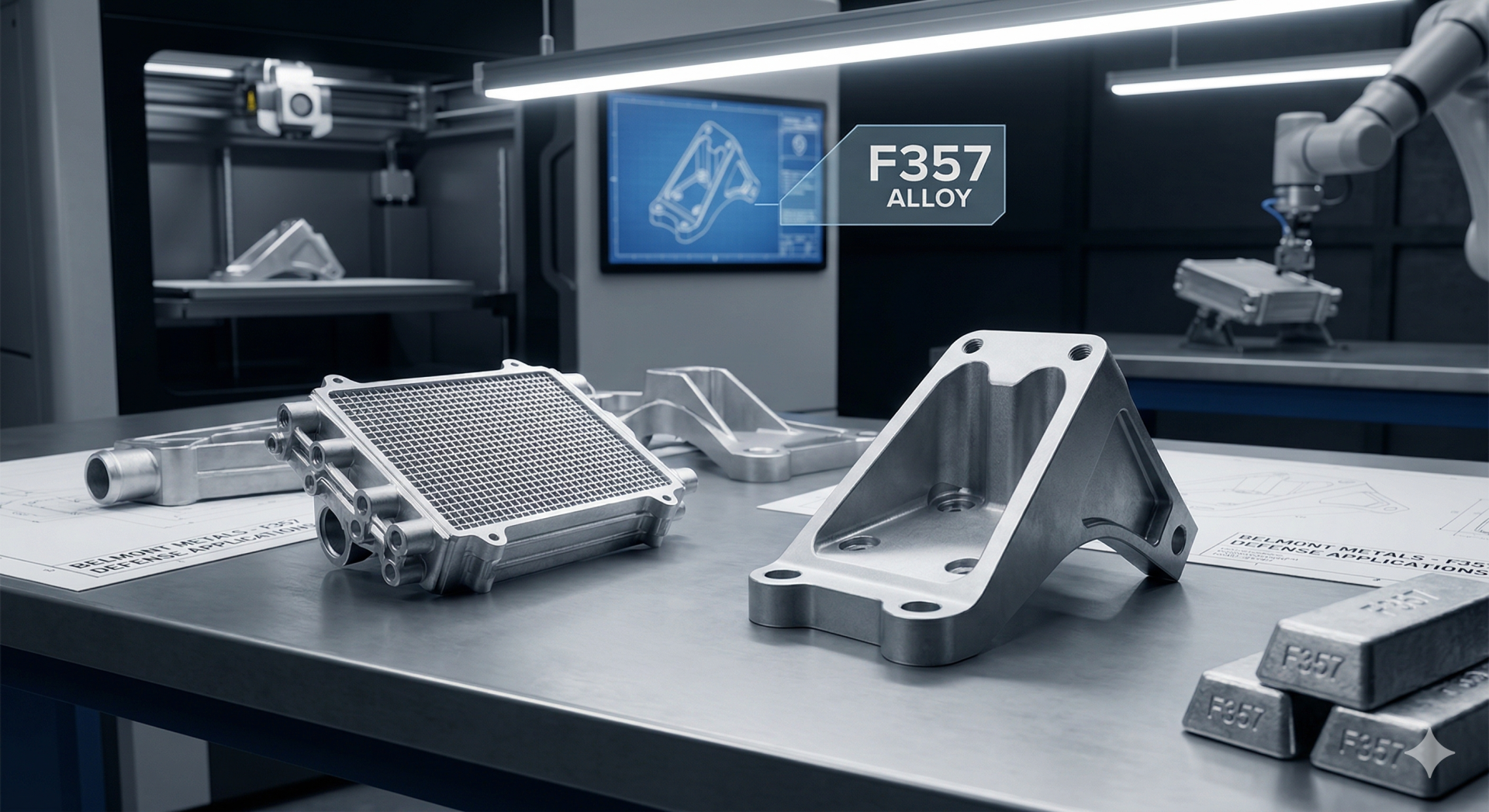
In the high-stakes world of defense manufacturing, engineers and procurement teams are constantly balancing the need for reduced weight with the absolute necessity of structural integrity. When traditional materials fall short of meeting both criteria, the F357 aluminum alloy emerges as a critical solution. As a premium, high-strength material, F357 provides the precise mechanical performance required for mission-critical defense components.
What is F357 Aluminum?
F357 is a highly specialized member of the Aluminum-Silicon-Magnesium (Al-Si-Mg) family. It is fundamentally the beryllium-free version of the widely used A357 casting alloy. While standard A357 contains trace amounts of beryllium—which presents complex health and safety handling concerns in modern manufacturing—F357 eliminates this toxic element entirely without sacrificing any metallurgical performance.
The alloy’s nominal composition is strictly controlled, typically containing roughly 7% silicon and 0.6% magnesium. Furthermore, F357 features stringent limits on trace impurities, such as iron. This high-purity profile reduces the risk of casting defects like porosity and inclusions, resulting in an exceptionally reliable and consistent material.
Key Properties of the F357 Alloy
Engineers and metal buyers consistently specify F357 because of its unique combination of thermal, physical, and mechanical characteristics:
-
Exceptional Strength-to-Weight Ratio: F357 offers high tensile and yield strength alongside a very low density. When heat-treated (typically to a T6 temper), it achieves peak mechanical properties and outstanding fatigue resistance, matching or exceeding the performance of heavier alternatives.
-
Autogenous Weldability: Standard high-strength aerospace alloys (like the 2000 or 7000 series) often suffer from poor weldability. Conversely, F357 is highly weldable without the need for filler materials, making it ideal for complex, multi-part assemblies.
-
Superior Corrosion Resistance: F357 maintains its structural integrity in harsh, oxidizing environments, a non-negotiable requirement for tactical and naval hardware.
-
Additive Manufacturing Excellence: Beyond traditional investment casting, F357 has become a premier choice for 3D printing and Laser Powder Bed Fusion (LPBF). The 7% silicon content increases the fluidity of the melt pool and minimizes contraction, striking the perfect balance between printability and final part strength.
F357 in Defense Applications
In the defense sector, material failure is not an option. F357 is heavily utilized to manufacture components that must endure dynamic mechanical stress and severe thermal loads. Common applications include:
-
Aerospace & Aviation: Auxiliary Power Units (APUs), drone components, and thin-walled structural housings rely on F357 to maximize weight reduction, thereby improving fuel efficiency and payload capacity.
-
Thermal Management Systems: Tactical vehicles and high-stress electronic systems utilize F357 for heat exchangers and cooling components, leveraging the alloy’s excellent thermal conductivity.
-
Load-Bearing Structures: Intricate brackets, gear housings, and structural mounts benefit from the alloy’s strength and dimensional accuracy.
At Belmont Metals (www.belmontmetals.com), we understand that the foundation of any successful engineering project is the quality of the raw material. Whether you are scaling up a traditional casting operation or developing cutting-edge additive manufacturing processes, we are here to supply the highest quality alloys for your most demanding applications.