
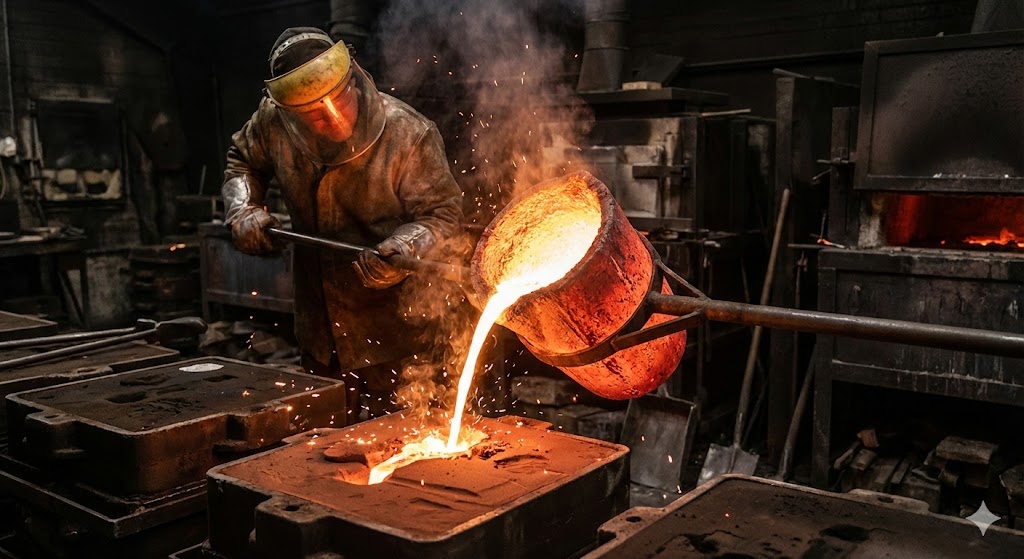
In the world of high-conductivity casting, oxygen is the persistent enemy. Molten copper is essentially a sponge for gas; if left untreated during the melting process, it readily absorbs oxygen from the atmosphere. Upon cooling, this dissolved oxygen reacts with the copper to form Copper Oxide (Cu2O) at the grain boundaries, leading to steam embrittlement, reduced ductility, and porous castings that fail under hydrostatic pressure.
To combat this, foundries universally use “deoxidizers.” The most common industry standard is Phosphorus-Copper (Phos-Copper). It is inexpensive, easy to handle, and effectively scrubs oxygen from the melt. However, for electrical applications, Phos-Copper comes with a massive, often overlooked hidden cost: Conductivity Loss.
The Physics of Conductivity
Electrical conductivity in metals is determined by the ability of electrons to move freely through the crystal lattice. Impurities disrupt this flow, scattering electrons and increasing resistance. Unfortunately, Phosphorus is one of the most damaging elements to copper’s conductivity profile.
Even a tiny residual amount of phosphorus—as little as 0.02%—can drastically drop the conductivity of pure copper from 101% IACS (International Annealed Copper Standard) down to 80% or lower. For a standard plumbing fitting or a decorative casting, this drop in performance is irrelevant. But for a switchgear component, a heavy-duty welding electrode, or a high-amperage connector, an 80% IACS rating is a failure. It means the component will run hotter, waste energy through resistance, and potentially melt down under peak load.
The Solution: “Invisible” Deoxidizers
To maintain high IACS ratings while ensuring a gas-free cast, engineers must use a deoxidizer that reacts with oxygen and then precipitates out or becomes inert, rather than dissolving into the copper matrix.
1. Copper-Boron (CuB): The Electrical Standard Boron is the premium choice for high-conductivity copper applications. Unlike phosphorus, boron has very low solubility in solid copper. When added via a 2% Boron Copper master alloy, the boron acts as a scavenger, grabbing oxygen atoms to form boron oxide, which floats to the surface as slag. Because the remaining boron does not stay in the copper solution, it does not impede electron flow. This allows foundries to achieve conductivities well above 95% IACS, making it the standard for electrical motor rotors and high-voltage transmission parts.
2. Copper-Lithium (CuLi): The Deep Cleaner For the most demanding applications, Lithium is a “double threat.” It is one of the few elements that effectively reacts with both oxygen and hydrogen (the primary cause of gas porosity). By using Copper-Lithium, foundries produce an exceptionally clean melt with a fluid slag that is easy to skim. It is frequently known as a “self-fluxing” deoxidizer and is the secret weapon for casting high-purity electronic-grade copper where porosity is non-negotiable.
Strength at Temperature: Copper-Zirconium
The challenge with pure, high-conductivity copper is that it is soft, especially at elevated temperatures. Pure copper begins to soften and lose its mechanical strength around 200°C.
By adding Zirconium via our Copper-Zirconium (CuZr) master alloy, you can raise that softening temperature to over 500°C without sacrificing conductivity. The zirconium precipitates along the grain boundaries, “pinning” them in place and preventing deformation under heat. This makes CuZr the ideal, cost-effective alternative to expensive Silver-bearing copper for high-stress electrical contacts and resistance welding tips.
Stop sacrificing power for purity. Contact our metallurgical team to discuss your melt specs and switch to a Master Alloy that respects your conductivity requirements.