
If you have been monitoring the precious metals market, you know the story: the price of gold and silver continues to see volatility, driven by industrial demand and global economic shifts. For art foundries, sculptors, and jewelry manufacturers, this presents a critical challenge. How do you maintain the “luxury” aesthetic and intricate detail your clients demand without pricing your finished pieces out of the market?
At Belmont Metals, we have been serving the casting community since 1896, and we have seen these cycles before. The most successful foundries adapt by exploring high-performance alternatives that offer the look and feel of precious metals at a fraction of the cost. This month, we are spotlighting two of our most versatile alloys: Art Caster’s Brass and White Bronze.
Mastering the “Golden” Look: Art Caster’s Brass
Standard silicon bronze (often referred to generically as Everdur) has long been the industry workhorse for statuary. However, when fine detail is paramount—such as in jewelry prototyping or intricate decorative hardware—standard bronze can sometimes lack the necessary fluidity.
Belmont’s Art Caster’s Brass is a specially formulated alloy designed to bridge the gap between industrial strength and artistic finesse.
-
Superior Fluidity: It has a lower melting point and higher fluidity than standard silicon bronze. This allows the molten metal to fill the finest crevices of a ceramic shell or plaster investment, capturing textures as subtle as a fingerprint or a strand of hair.
-
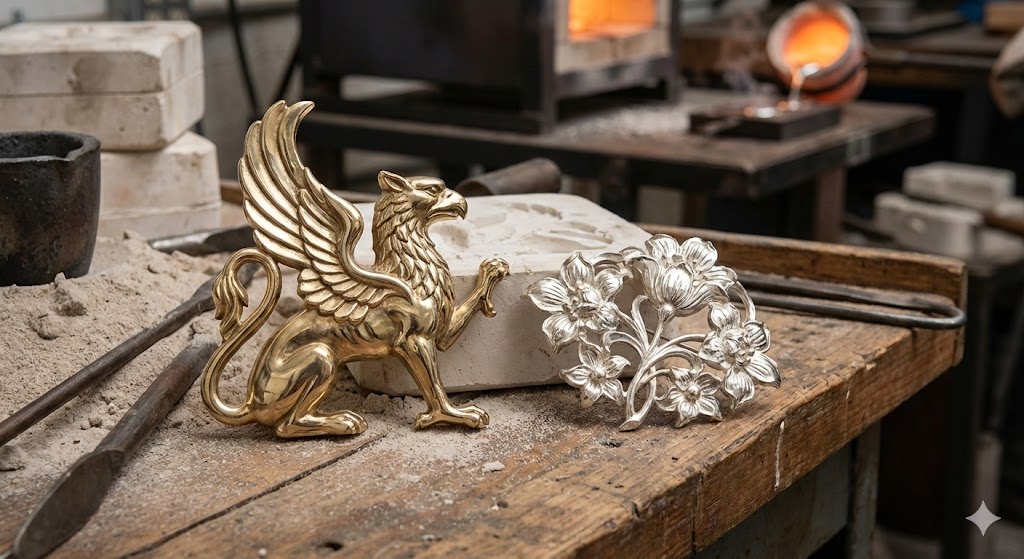
The Finish: When polished, Art Caster’s Brass yields a warm, rich yellow-gold color that is virtually indistinguishable from 14k gold to the untrained eye. It also takes patinas exceptionally well, allowing artists to achieve a range of finishes from antique brown to verdant green.
The “Silver” Standard: White Bronze
For those seeking the cool elegance of silver, White Bronze is a metallurgical marvel. It is a copper-based alloy with high levels of tin and zinc, engineered to mimic the color and luster of sterling silver.
-
Cost Stability: Because it contains no actual silver, the price is stable and predictable, allowing for easier quoting on large projects.
-
Tarnish Resistance: One of the hidden benefits of White Bronze is its resistance to tarnishing. Unlike sterling silver, which requires frequent polishing to combat oxidation, White Bronze maintains its bright finish for longer periods, making it ideal for architectural elements and public art.
Technical Tip: Both alloys require specific gating and spruing techniques to minimize shrinkage porosity. Our metallurgical team can provide guidance on the optimal pouring temperatures (typically around 1,950°F – 2,050°F for these brasses) to ensure a defect-free casting.
Don’t let the commodities market dictate your creativity. Contact our team today to request a sample of our Art Caster’s Brass or White Bronze and see the difference in your next pour.