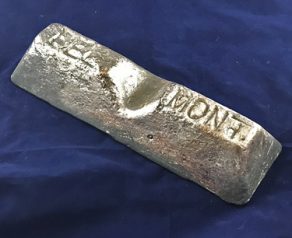
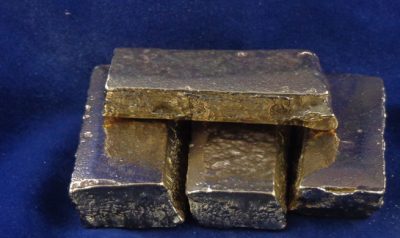
70/30 Copper Nickel UNS C96400 is a copper-nickel casting alloy with a nominal composition of 66% Cu, 30.9% Ni, 0.4% Si, 1% Mn, 0.7% Fe, and 1% Cb, conforming to CDA number 96400. The high nickel content provides exceptional resistance to corrosion and erosion in aggressive seawater environments, while iron and manganese additions improve strength and resistance to impingement attack under high-velocity flow conditions. C96400 is specified for demanding marine and industrial applications where high temperatures and pressures combine with high flow velocities and turbulence. Typical applications include seawater piping systems, condenser components, pump impellers, and valve bodies in naval vessels, offshore platforms, and power generation facilities. Supplied in 2-20 lb ingots for foundry casting of marine hardware and industrial pressure components.
Available Forms
2-20 Ingot
Product Code
47025
Technical Info
Thermal Properties
Melting Point (Solidus)621
Melting Point (Liquidus)1832
Physical Properties
Density (imperial)0.35
Density (metric)9.69
Physical Properties
Primary ElementsCu, Fe, Mn, Nb, Ni, Si
SpecificationCDA C96400
Lead FreeYes
Performance tags
Erosion ResistantHigh Temperature RatedHigh-Velocity Seawater ResistantMarine Grade
Nominal Composition
66% Cu
30.9% Ni
1% Cb
1% Mn
0.7% Fe
0.4% Si
Frequently Asked Questions
Common technical inquiries regarding 70/30 Copper Nickel UNS C96400
C96400 (70/30) contains nearly three times the nickel of C96200 (90/10), giving it significantly better resistance to corrosion, erosion, and impingement attack in high-velocity seawater and aggressive chloride environments. The 70/30 grade is justified when flow velocities are high, when service involves turbulence or entrained solids, or when operating temperatures are elevated. For lower-velocity seawater service at near-ambient temperatures, C96200 provides adequate performance at lower material cost.
Columbium at approximately 1% acts as a grain refiner and carbide stabilizer in C96400, improving elevated-temperature strength and reducing the risk of sensitization in welded components. It also contributes to resistance to intergranular corrosion in service. The columbium addition is particularly important for welded piping and heat exchanger components where the heat-affected zone must retain corrosion resistance equivalent to the base metal.
C96400 should be melted under a protective flux cover to minimize nickel and manganese oxidation losses. Pouring temperature should be controlled at 150-200F above the liquidus to ensure complete fill without excessive turbulence. Degassing with nitrogen before pouring is recommended for thick-section components where hydrogen porosity is a risk. All pressure-containing castings should be hydrostatically tested after machining per the applicable ASME or naval specification.