Lead-freeSuperior Corrosion Resistance vs Tin-Lead SoldersComparable to Pure ZincAluminum-to-Aluminum SolderingActive Flux Required
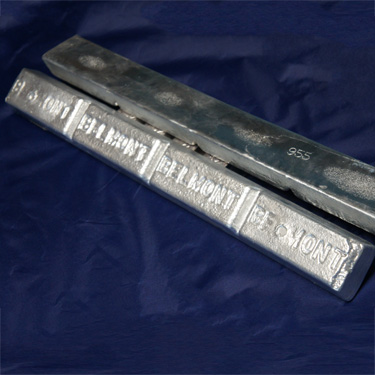
95% Zn / 5% Al zinc-aluminum solder with superior corrosion resistance. Forms: capping bar; 4-20 ingot; and regular bars. Used for aluminum-to-aluminum and aluminum-to-zinc soldering.
95/5 Zinc Aluminum Solder Alloy is composed of 95% zinc and 5% aluminum producing a solder with remarkable corrosion resistance and adhesion that surpasses conventional tin-lead solders for aluminum joining applications. The alloy’s resistance to corrosion at soldered joints is comparable to pure zinc – significantly better than tin-lead or tin-silver-copper solders which create galvanic couples with aluminum that accelerate joint corrosion. The 5% aluminum addition improves the alloy’s wetting on aluminum base metals and lowers the melting range from pure zinc toward a more workable temperature range for soldering operations. 95/5 Zn-Al is used for joining aluminum to aluminum in HVAC assemblies; heat exchangers; automotive cooling systems; and electrical enclosures; and for joining aluminum to zinc-coated (galvanized) steel where galvanic compatibility between the solder and base metals is required. Flux selection is critical for aluminum soldering with this alloy – standard rosin fluxes are ineffective and active zinc chloride-type or fluoride-based fluxes are required. Forms: 1/4 lb capping bar; 4-20 lb ingot; and approximately 1 lb regular bars.
Available Forms
1/4# Capping Bar, 4-20 Ingot, Approx. 1 Lb. Regular Bars
Product Code
8951
Technical Info
Thermal Properties
Melting Point (Solidus)720°F (382°C)
Melting Point (Liquidus)720°F (382°C)
Physical Properties
Density (imperial)0.238 lbs/in³
Density (metric)6.59 g/cm³
Primary ElementsZn · Al
Lead FreeYes
Key Features
Superior Corrosion Resistance vs Tin-Lead SoldersComparable to Pure ZincAluminum-to-Aluminum SolderingActive Flux Required
Nominal Composition
95% Zn
5% Al
Frequently Asked Questions
Common technical inquiries regarding 95/5 Zinc Aluminum Solder Alloy
When tin-lead solder is used to join aluminum the electrochemical potential difference between the tin-lead alloy and the aluminum base metal creates a galvanic couple in the presence of moisture - the aluminum (more anodic) corrodes preferentially at the joint interface weakening the joint and potentially causing leakage in sealed assemblies. Zinc-aluminum solder has an electrochemical potential much closer to aluminum in the galvanic series minimizing the driving force for galvanic corrosion at the joint. The result is a joint that corrodes at approximately the same rate as the aluminum base metal rather than preferentially at the solder interface.
Zinc-aluminum solder requires an aggressive flux to penetrate the tenacious aluminum oxide layer - typically zinc chloride-based active fluxes or fluoride-containing fluxes designed for aluminum soldering. Standard organic acid (OA) fluxes for copper are generally insufficient for aluminum. Zinc chloride flux residues are highly corrosive to aluminum if not completely removed after soldering and thorough hot water rinsing immediately after cooling is essential. Fluoride-based fluxes used in furnace brazing are more benign residue-wise but require higher process temperatures.
With a solidus of 717F (381C) and liquidus of 727F (386C) the 95/5 Zn-Al solder is typically applied at 750-850F (399-454C). Torch soldering with propane or natural gas is the most common heating method for field and workshop use. Hot air soldering and resistance heating are also used for production applications. Furnace brazing is used for high-volume production of aluminum heat exchangers and assemblies. The base metal must be brought to soldering temperature before introducing the solder - the alloy should flow freely on contact with the heated base metal without direct flame impingement on the solder rod.