
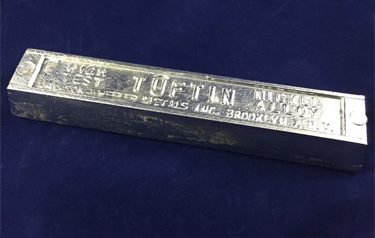
Product Code: J1

Tuftex Duratex Alloy

Nickel-Modified Lead-Base Babbitt Increased Hardness Higher Load Capacity Than Standard Lead Babbitt Jackson Wheeler Proprietary
Proprietary lead-base alloy with nickel addition for increased hardness. Forms: ingot.
Solidus
462°F (239°C)
Liquidus
487°F (253°C)
Density
0.361 lbs/in³ (10 g/cm³)
Primary Elements
Pb · Sb · Sn · Ni · Cu
Nominal Composition
Proprietary
Custom request

Can't find the right composition?

Product Overview

Tuftex Duratex Alloy is a proprietary lead-base bearing alloy formulated by Jackson Wheeler with a small addition of nickel to provide increased hardness compared to standard lead-base Babbitt compositions. Nickel additions to lead-base alloys refine the microstructure and increase hardness and strength improving the alloy’s load-carrying capacity and wear resistance at the cost of some embeddability relative to softer lead Babbitt grades. Duratex is suited for bearing applications requiring higher hardness than standard lead Babbitt can provide while still benefiting from the conformability and corrosion resistance of the lead-base alloy system. Composition details beyond the lead base and nickel addition are proprietary. Forms: ingot.

Product Code

J1

Technical Info

Thermal Properties

Melting Point (Solidus)462°F (239°C)
Melting Point (Liquidus)487°F (253°C)

Physical Properties

Density (imperial)0.361 lbs/in³
Density (metric)10 g/cm³
Primary ElementsPb · Sb · Sn · Ni · Cu
Lead FreeNo — contains lead
Key Features
Nickel-Modified Lead-Base BabbittIncreased HardnessHigher Load Capacity Than Standard Lead BabbittJackson Wheeler Proprietary

Nominal Composition

  • Proprietary

Frequently Asked Questions

Common technical inquiries regarding Tuftex Duratex Alloy
Nickel has very low solid solubility in lead and forms fine nickel-lead intermetallic compounds distributed throughout the alloy microstructure during solidification. These intermetallics act as hard second-phase particles that increase the alloy's resistance to indentation and plastic deformation under bearing load. The nickel addition also refines the overall solidification microstructure contributing to improved mechanical properties.
Duratex's increased hardness makes it more appropriate for bearing applications with higher unit loads where a softer standard lead Babbitt would deform plastically under load. Applications with moderate-to-heavy loads at low-to-medium speeds such as rolling mill bearings; large industrial pump bearings; and heavy equipment journal bearings benefit from the added hardness. Standard soft lead Babbitt is preferred for very light loads where maximum embeddability is needed to handle contaminated lubricants.
The relining process for Duratex follows the same general procedure as other lead-base Babbitt alloys: clean and tin the bearing housing; heat to the appropriate temperature; and pour molten alloy around a mandrel. The primary difference may be in pouring temperature and solidification rate due to the nickel addition modifying the alloy's melting range relative to standard lead Babbitt. Specific processing parameters should be obtained from Belmont Metals or Jackson Wheeler.

Request a Quote

Complete our Quote form, and we'll respond with options for you!