
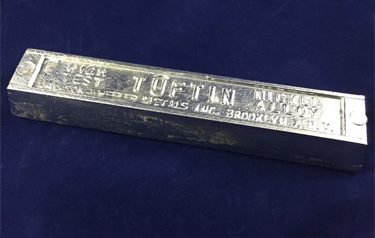
Product Code: F10

Tuftin Nickel Genuine #1

Lead-freeNickel-Enhanced Strength High-Performance Tin Babbitt Turbine and Compressor Bearing Grade
Proprietary tin-base Babbitt similar to ASTM B23 Grade 2 with nickel additions for enhanced strength. Forms: ingot.
Solidus
464°F (240°C)
Liquidus
705°F (374°C)
Density
0.266 lbs/in³ (7.36 g/cm³)
Primary Elements
Sn · Sb · Ni · Cu
Nominal Composition
Proprietary
Custom request

Can't find the right composition?

Product Overview

Tuftin Nickel Genuine #1 is a proprietary tin-base Babbitt alloy in the Jackson Wheeler Tuftin line formulated with nickel additions to enhance strength beyond that of standard ASTM B23 Grade 2 Babbitt. ASTM B23 Grade 2 is the most widely used high-performance tin Babbitt grade for steam turbine; compressor; and high-load industrial bearing applications. Nickel Genuine #1 uses this well-established tin-base composition as its starting point and adds controlled nickel to further refine the microstructure and increase mechanical strength. Nickel additions to tin Babbitt produce a finer more uniform dispersion of hard phases (including nickel-tin intermetallics) that increase hardness; tensile strength; and fatigue resistance. Forms: ingot.

Product Code

F10

Technical Info

Thermal Properties

Melting Point (Solidus)464°F (240°C)
Melting Point (Liquidus)705°F (374°C)

Physical Properties

Density (imperial)0.266 lbs/in³
Density (metric)7.36 g/cm³
Primary ElementsSn · Sb · Ni · Cu
Lead FreeYes
Key Features
Nickel-Enhanced StrengthHigh-Performance Tin BabbittTurbine and Compressor Bearing Grade

Nominal Composition

  • Proprietary

Frequently Asked Questions

Common technical inquiries regarding Tuftin Nickel Genuine #1
Nickel in tin Babbitt forms Ni3Sn4 intermetallic particles that are distributed throughout the tin matrix providing additional hardness and fatigue resistance beyond what the standard SbSn and Cu6Sn5 phases of Grade 2 achieve. Nickel also refines the overall microstructure by acting as a nucleation agent during solidification producing smaller more uniformly distributed hard phases. The combined effect is a measurable increase in hardness (typically 5-15% above Grade 2); tensile strength; and improved fatigue life under cyclic loading at elevated temperatures.
Qualification for turbine bearing applications typically involves chemical composition verification against the specified alloy range; hardness testing of production lots to confirm specification compliance; bond quality inspection (ultrasonic testing) of the finished bearing liner; and dimensional inspection. For critical turbomachinery applications a first article bearing may be subjected to load testing in a bearing test rig before approval for production use. The similarity of Nickel Genuine #1 to ASTM B23 Grade 2 allows the existing qualification infrastructure for Grade 2 to be adapted with minor modification.
Tinning for tin-base Babbitt bearing relining typically uses pure tin or a tin-based soldering alloy applied as a liquid coat to the cleaned bearing shell surface. The bearing shell is cleaned to bare metal by sandblasting; wire brushing; or chemical etching then fluxed with a zinc chloride or muriatic acid flux and heated to approximately 450-500F. Molten tinning compound is applied and distributed with a brush or swab to produce a thin uniform bright tin coating. The Babbitt is then poured onto the tinned surface while it is still hot. A properly tinned surface produces a strong metallurgical bond.

Request a Quote

Complete our Quote form, and we'll respond with options for you!