
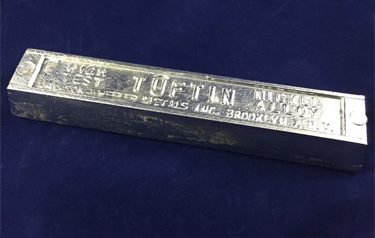
Product Code: C3

Tuftex Chipper Alloy

Proprietary Lead-Base Wood Chipper Knife Application Impact and Wear Resistance Jackson Wheeler Formulation
Proprietary lead-base alloy for wood chipper knife manufacturing. Forms: ingot.
Solidus
469°F (243°C)
Liquidus
484°F (251°C)
Density
0.375 lbs/in³ (10.37 g/cm³)
Primary Elements
Pb · Sb · Sn · Ni · Cu
Nominal Composition
Proprietary
Custom request

Can't find the right composition?

Product Overview

Tuftex Chipper Alloy is a proprietary lead-base alloy developed by Jackson Wheeler specifically for use in the manufacture of wood chipper knives. Wood chipper knives are high-wear components subject to repeated impact and abrasion from wood fiber and debris requiring a backing material that can absorb shock; provide a stable base for the cutting edge; and resist the wear conditions of the chipping environment. The proprietary lead-base composition of Chipper Alloy is formulated to provide the specific hardness; toughness; and machinability properties required for this application differentiating it from general-purpose lead Babbitt alloys. Composition is proprietary and not publicly disclosed. Forms: ingot.

Product Code

C3

Technical Info

Thermal Properties

Melting Point (Solidus)469°F (243°C)
Melting Point (Liquidus)484°F (251°C)

Physical Properties

Density (imperial)0.375 lbs/in³
Density (metric)10.37 g/cm³
Primary ElementsPb · Sb · Sn · Ni · Cu
Lead FreeNo — contains lead
Key Features
Proprietary Lead-BaseWood Chipper Knife ApplicationImpact and Wear ResistanceJackson Wheeler Formulation

Nominal Composition

  • Proprietary

Frequently Asked Questions

Common technical inquiries regarding Tuftex Chipper Alloy
In wood chipper knife assemblies lead-base alloy is used as a backing or bedding material that supports the hardened steel cutting edge; absorbs impact loads transmitted through the cutting edge during chipping; and provides a conformable interface between the steel knife and the chipper housing. The alloy's combination of moderate hardness and toughness prevents the backing material from cracking under impact while providing enough strength to hold the cutting edge in register. The low melting point of lead-base alloys allows the backing material to be cast around the knife components in a relatively simple operation.
Standard lead Babbitt grades (ASTM B23 Grades 7 and 8) are formulated primarily for bearing applications where sliding contact loads; embeddability; and oil compatibility are the design criteria. Wood chipper knife backing materials experience primarily impact loading rather than sliding contact - the required property balance (impact resistance; hardness; and machinability) may differ from what standard bearing Babbitt grades provide. A proprietary formulation allows optimization of these specific properties for the chipper knife application without the constraints of the standard grade composition ranges.
Specific casting temperature data for Tuftex Chipper Alloy is not Forms: the composition is proprietary. As a lead-base alloy the casting temperature is expected to be in the range typical for lead Babbitt alloys - approximately 600-750F (315-400C) at 50-100F above the liquidus. Steel or iron molds are typically used for casting lead-base alloys in industrial applications preheated to 200-300F to control solidification rate. Contact Belmont Metals or Jackson Wheeler directly for specific pouring and processing parameters for this proprietary alloy.

Request a Quote

Complete our Quote form, and we'll respond with options for you!