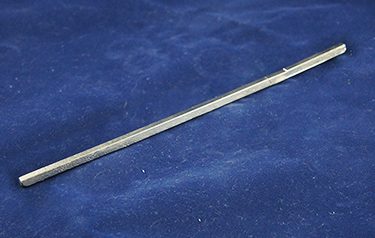
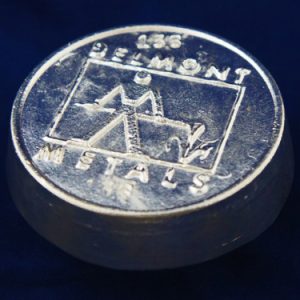
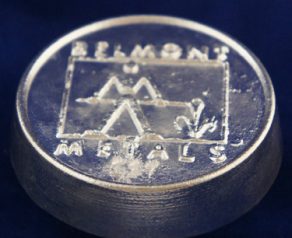
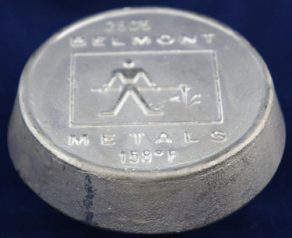
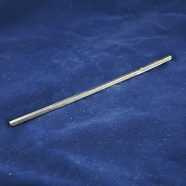
2 lb Cake FormAntique Repair GradeCapping Bar FormCustom Block and Fixture Grade
Bismuth-lead-tin-cadmium non-eutectic alloy (50% Bi, 25% Pb, 12.5% Sn, 12.5% Cd) with 158-169°F range for low-melting solder, metal inlays, and antique repair.
Wood’s Metal is a bismuth-lead-tin-cadmium non-eutectic alloy with a nominal composition of 50% Bi, 25% Pb, 12.5% Sn, and 12.5% Cd, with a solidus of 158°F (70°C) and liquidus of 169°F (76°C). Density is 0.347 lbs/in. Short-term tensile strength is 6,100 lbs/in and Brinell hardness is 9.3. Dimensional change is very small: -0.0001 in/in at 2 minutes, 0.0002 at 1 hour, 0.0031 at 24 hours, and 0.0035 at 500 hours — one of the most dimensionally stable of all low melting alloys over the full time range. Wood’s Metal is historically one of the most widely used fusible alloys, valued for its very low melting point (melts in boiling water with adequate dwell time at 212°F), near-zero dimensional change, and ability to produce fine surface detail in cast replicas. Applications include low-melting solder for heat-sensitive joints, metal inlays in decorative woodworking and furniture, antique repair where the low melting temperature prevents damage to original materials, and custom shaped blocks and fixtures. Note: this alloy contains cadmium and lead — appropriate ventilation and PPE are required during melting. Available in capping bars, cakes, and 1/4 and 1/8 inch diameter solid wire.
Available Forms
Cakes, Capping Bars
Product Code
2502
Technical Info
Thermal Properties
Melting Point (Solidus)158
Melting Point (Liquidus)169
Physical Properties
Density (imperial)0.347
Density (metric)9.6
Physical Properties
Primary ElementsBi, Cd, Pb, Sn
Lead FreeNo — contains lead
Performance tags
2 lb Cake FormAntique Repair GradeCapping Bar FormCustom Block and Fixture GradeFits Narrow CavitiesFusible Device GradeHot Water Bath MeltableLow-Melting SolderMetal Inlay for WoodworkingNear-Zero Dimensional ChangePrecision Metered Additions
Nominal Composition
50% Bi
25% Pb
12.5% Cd
12.5% Sn
Frequently Asked Questions
Common technical inquiries regarding WOODS Metal, 158-169 F, 70-76 C Low Melting Alloy
Decorative channels are routed or carved into the wood surface and the alloy is poured molten at approximately 180-190°F directly into the channels, filling them completely. The alloy solidifies within seconds at room temperature and can be filed, scraped, and sanded flush with the wood surface when fully cool. The soft, easily worked alloy accepts fine surface finishing with standard woodworking tools. Most wood species are compatible — the low pour temperature does not scorch the wood. Oil and wax finishes are applied over the inlay after surface preparation; film-building finishes (lacquer, polyurethane) adhere normally over Wood's Metal but adhesion should be tested for specific formulations.
Wood's Metal's key advantage for antique repair is its very low melting temperature of 158-169°F — it melts well below the degradation temperature of most antique finishes, lacquers, tortoiseshell, horn, celluloid, ivory, and vintage plastics that would be destroyed by standard soldering temperatures. It is used for joining metal components on antique instruments, clocks, and decorative objects where conventional soldering would darken or blister adjacent finishes; for filling small losses in metal ornamental work; and for casting replacement parts for lost decorative elements. The near-zero dimensional change ensures accurate fit of cast replacement pieces.
Wood's Metal wire can be used for very low current electrical connections where the soldering temperature must remain below 175°F — for example, soldering connections to heat-sensitive sensors, piezoelectric elements, and thermocouple junctions that would be damaged by standard solder temperatures. Electrical conductivity is moderate (approximately 10-15% IACS) — adequate for signal-level connections but not for power conductors. Joint shear strength is approximately 1,500-2,000 psi — suitable for static connections but not for mechanically stressed joints. Standard rosin flux or a mild liquid flux is required for wetting. The cadmium content requires ventilation during soldering in any enclosed space.
Five-component eutectic fusible alloy, 44.7% Bi / 22.6% Pb / 19.1% In / 8.3% Sn / 5.3% Cd. Melting point 117°F (47°C). Used for lens blocking and tooling aids.
CAST Metal, 281-338 F, 138-170 C Low Melting Alloy
Bismuth-tin non-eutectic alloy (40% Bi, 60% Sn) with 281-338°F (138-170°C) melting range for lost-pattern casting, proof casting, and low-temperature sealing.
Eutectic fusible alloy, 50% Bi / 26.7% Pb / 13.3% Sn / 10% Cd. Melting point 158°F (70°C). Used for tube bending, work-holding, and fusible safety devices.