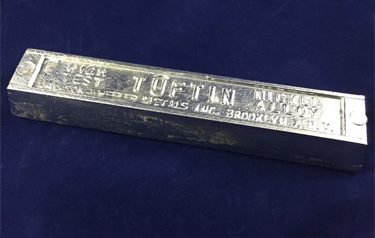
Tuftin Duratin is a proprietary tin-base Babbitt alloy in the Jackson Wheeler Tuftin line formulated for medium load bearing applications. Tin-base Babbitt alloys are characterized by higher strength; hardness; and fatigue resistance than lead-base Babbitt grades making them suitable for medium-to-high load and medium-speed bearing applications where lead Babbitt’s softer properties are insufficient. Duratin’s proprietary tin-base formulation targets the medium load segment of the bearing performance range – providing more load capacity than lead Babbitt while maintaining the conformability and corrosion resistance benefits of the tin-base alloy system. Composition details are proprietary. Forms: ingot.
Product Code
W1
Technical Info
Thermal Properties
Melting Point (Solidus)363°F (184°C)
Melting Point (Liquidus)491°F (255°C)
Physical Properties
Density (imperial)0.285 lbs/in³
Density (metric)7.88 g/cm³
Primary ElementsPb · Sb · Sn · Ni · Cu · Te
Lead FreeNo — contains lead
Key Features
Tin-Base BabbittMedium Load ApplicationsHigher Strength Than Lead BabbittJackson Wheeler Formulation
Nominal Composition
Proprietary
Frequently Asked Questions
Common technical inquiries regarding Tuftin Duratin
Tin-base Babbitt alloys (tin as the primary matrix metal with antimony and copper additions) have higher hardness (Brinell 20-30 versus 12-18 for lead Babbitt); higher tensile strength; and significantly better fatigue resistance under cyclic loading. These properties make tin-base alloys capable of sustaining higher bearing unit pressures and higher shaft speeds before bearing fatigue and wiping occur. The trade-off is that tin-base alloys are somewhat less conformable and have lower embeddability than lead-base grades - they are less forgiving of shaft misalignment and contaminated lubricants but provide superior performance in well-maintained properly aligned bearing systems.
Medium load tin-base Babbitt applications include centrifugal pump bearings; electric motor journal bearings; industrial gearbox bearings; steam turbine bearings; marine main engine bearings; and general industrial machinery journal bearings operating at moderate to high shaft speeds. These applications involve continuous rotation at defined speeds with pressurized oil lubrication where the superior fatigue strength of tin Babbitt over lead Babbitt provides meaningful bearing life extension.
Standard tin-base Babbitt alloys (ASTM B23 Grade 1; 2; 3) are typically poured at 700-800F (370-425C). For Tuftin Duratin as a proprietary alloy the specific pouring temperature should be obtained from Belmont Metals or Jackson Wheeler. General guidance for tin-base Babbitt relining is to pour at 50-100F above the fully molten (mirror-bright) temperature of the alloy. Overheating tin Babbitt causes tin oxidation (dross formation) and alloy segregation that reduces bearing quality.