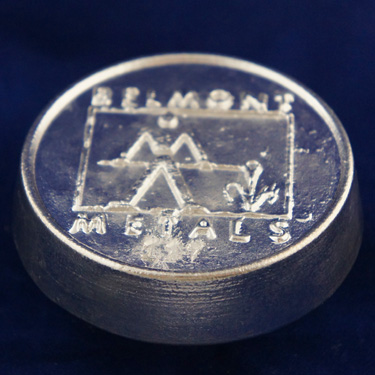
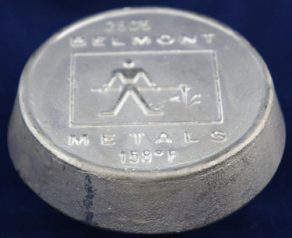
Melotte’s Metal is a bismuth-lead-tin eutectic alloy with a nominal composition of 52.5% Bi, 32% Pb, and 15.5% Sn, melting sharply at 203°F (95°C). Solidus and liquidus are both 203°F, confirming true eutectic behavior. Density is 0.35 lbs/in. Short-term tensile strength is 6,100 lbs/in and Brinell hardness is 9 — the softest in the low melting range. The alloy shows significant growth after casting: negligible at 2 minutes, jumping to 0.0055 in/in at 1 hour, 0.0057 at 24 hours, and reaching 0.0061 at 500 hours. Melotte’s Metal is cast to conform to patient anatomy for individualized radiation shielding blocks used in cancer radiotherapy treatment planning, where the alloy’s low melt temperature allows casting around wax or foam anatomical models without damage, and the cadmium-free composition is required for medical use. Additional applications include fusible links in fire suppression systems, anchoring bolts and inserts in low-temperature environments, and general low-melting casting where the 203°F melt point offers a process advantage over higher melting alternatives. Forms: cakes, 1/8 and 1/32 inch diameter solid wire, irregular shot, and pigs.
Medical Radiation Shielding GradeEutectic Sharp Melt at 203°FCadmium-FreeRapid Post-Casting Growth
Nominal Composition
52.5% Bi
32% Pb
15.5% Sn
Frequently Asked Questions
Common technical inquiries regarding Melotte's Metal, 203 F, 95 C Low Melting Alloy
In radiation therapy treatment planning, custom-shaped lead alloy shielding blocks are cast to protect healthy tissue adjacent to the treatment field from scatter radiation. A Styrofoam or wax anatomical template is created from the patient's CT scan data, placed in a mold box, and Melotte's Metal is poured around it at approximately 220-230°F. After solidification, the foam is removed, leaving a patient-specific shield with the exact cutout geometry required. Melotte's Metal is specified for medical applications because it is cadmium-free — cadmium is highly toxic and its absence eliminates occupational exposure risk to radiation therapists who handle the blocks daily. The 203°F melt point also prevents damage to Styrofoam patterns used in mold construction.
Melotte's Metal at 0.35 lbs/in density provides somewhat less attenuation per unit thickness than pure lead (0.41 lbs/in), requiring approximately 17% greater thickness to achieve equivalent attenuation. For standard megavoltage radiotherapy (4-18 MV linear accelerator beams), 3-4 inches of Melotte's Metal provides acceptable attenuation for field shaping blocks. The alloy's ease of casting to precise shapes and its low handling temperature more than compensate for the modest thickness penalty compared to pure lead in the clinical workflow. Medical physics department protocols define the specific block thickness required for each energy and clinical application.
Fusible links in fire suppression systems (sprinkler heads, fire dampers, door release mechanisms) are designed to melt at a specific temperature, triggering the device. Melotte's Metal's 203°F (95°C) eutectic temperature corresponds to a response temperature class used in residential and standard commercial sprinkler heads — the link melts reliably and sharply at the activation temperature without a mushy intermediate phase that could delay response. The sharp eutectic melt (no freezing range) is critical for consistent, predictable activation temperature. Standard sprinkler rating temperatures range from approximately 135°F to 300°F; the 203°F class is used in areas where ambient temperatures do not normally exceed 100°F.
Five-component eutectic fusible alloy, 44.7% Bi / 22.6% Pb / 19.1% In / 8.3% Sn / 5.3% Cd. Melting point 117°F (47°C). Used for lens blocking and tooling aids.
CAST Metal, 281-338 F, 138-170 C Low Melting Alloy
Bismuth-tin non-eutectic alloy (40% Bi, 60% Sn) with 281-338°F (138-170°C) melting range for lost-pattern casting, proof casting, and low-temperature sealing.
Eutectic fusible alloy, 50% Bi / 26.7% Pb / 13.3% Sn / 10% Cd. Melting point 158°F (70°C). Used for tube bending, work-holding, and fusible safety devices.
To provide the best experiences, we use technologies like cookies to store and/or access device information. Consenting to these technologies will allow us to process data such as browsing behavior or unique IDs on this site. Not consenting or withdrawing consent, may adversely affect certain features and functions.
Functional
Always active
The technical storage or access is strictly necessary for the legitimate purpose of enabling the use of a specific service explicitly requested by the subscriber or user, or for the sole purpose of carrying out the transmission of a communication over an electronic communications network.
Preferences
The technical storage or access is necessary for the legitimate purpose of storing preferences that are not requested by the subscriber or user.
Statistics
The technical storage or access that is used exclusively for statistical purposes.The technical storage or access that is used exclusively for anonymous statistical purposes. Without a subpoena, voluntary compliance on the part of your Internet Service Provider, or additional records from a third party, information stored or retrieved for this purpose alone cannot usually be used to identify you.
Marketing
The technical storage or access is required to create user profiles to send advertising, or to track the user on a website or across several websites for similar marketing purposes.