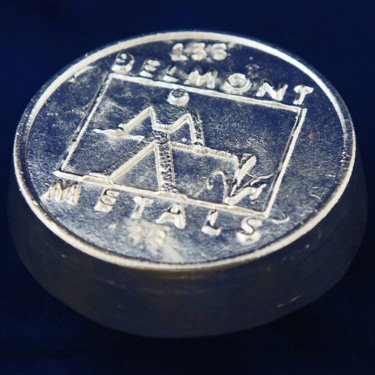
MATRIX Metal is a bismuth-lead-tin-antimony non-eutectic alloy with a nominal composition of 48% Bi, 28.5% Pb, 14.5% Sn, and 9% Sb, with a solidus of 218°F (103°C) and liquidus of 440°F (227°C) — the widest freezing range of any Belmont low melting alloy. Density is 0.343 lbs/in. Short-term tensile strength is 13,000 lbs/in — the highest in the low melting range — and Brinell hardness is 19. The alloy grows significantly after casting: 0.0008 inches per inch at 2 minutes, increasing to 0.0048 at 1 hour, 0.0051 at 24 hours, and continuing to 0.0061 at 500 hours. This substantial growth after casting is the key property exploited in its primary applications — as the alloy grows, it locks itself tightly against the walls of a mold cavity or around a workpiece, creating a self-tightening holding grip. Originally developed for producing punch dies, the alloy is now widely used to make chuck jaws, holding plates, and work-holding devices for machining irregular parts that cannot be gripped with standard round jaws. Forms: 2 lb cake form.
Available Forms
Cakes
Product Code
2481
Technical Info
Thermal Properties
Melting Point (Solidus)217°F (103°C)
Melting Point (Liquidus)440°F (227°C)
Physical Properties
Density (imperial)0.343 lbs/in³
Density (metric)9.5 g/cm³
Primary ElementsBi · Pb · Sn · Sb
Lead FreeNo — contains lead
Key Features
Self-Tightening Growth After CastingHighest Tensile Strength in RangeChuck Jaw and Holding Fixture GradeWidest Freezing Range
Nominal Composition
48% Bi
28.5% Pb
14.5% Sn
9% Sb
Frequently Asked Questions
Common technical inquiries regarding MATRIX Metal, 218-440 F, 103-227 C Low Melting Alloy
When MATRIX Metal is cast around a workpiece or into a fixture mold, it initially solidifies with a slight contraction at the eutectic point (218°F), then undergoes progressive growth as it cools to room temperature and continues over the following hours. The growth — from 0.0008 at 2 minutes to 0.0061 at 500 hours — exerts a progressively increasing clamping force on the workpiece or against the fixture walls as the alloy expands. This self-tightening mechanism creates a holding grip that improves over the first day after casting and remains stable at 500 hours, eliminating the loosening that can occur with thermal contraction in conventional fixture casting alloys.
Mount the part in the lathe or fixture at the required orientation and surround the gripping surfaces with a sheet metal or cardboard dam to contain the molten alloy. Pour MATRIX Metal at approximately 460-480°F (above the 440°F liquidus) into the space between the chuck jaws and the part, filling the void completely. Allow to cool for a minimum of 1 hour — preferably 24 hours — before beginning machining operations, allowing the growth phase to fully grip the workpiece. The final grip strength is significantly higher after 24 hours than after 1 hour. When machining is complete, heat the assembly above 250°F to melt out the alloy and recover both the workpiece and the alloy for reuse.
MATRIX Metal's solidus of 218°F (103°C) sets the upper limit for structural service — at this temperature the alloy begins to soften and lose its gripping force. For safe machine shop holding applications, limit the workpiece and fixture temperature to no more than 180°F (82°C) to maintain an adequate safety margin against sudden fixture failure. In practice, most ambient-temperature machining operations do not approach this limit, but flood coolant directed at the cutting zone rather than the fixture is recommended to prevent heat buildup in the alloy during prolonged cutting operations on high-conductivity metals.
Five-component eutectic fusible alloy, 44.7% Bi / 22.6% Pb / 19.1% In / 8.3% Sn / 5.3% Cd. Melting point 117°F (47°C). Used for lens blocking and tooling aids.
CAST Metal, 281-338 F, 138-170 C Low Melting Alloy
Bismuth-tin non-eutectic alloy (40% Bi, 60% Sn) with 281-338°F (138-170°C) melting range for lost-pattern casting, proof casting, and low-temperature sealing.
Eutectic fusible alloy, 50% Bi / 26.7% Pb / 13.3% Sn / 10% Cd. Melting point 158°F (70°C). Used for tube bending, work-holding, and fusible safety devices.