Home / Solders / 158-169 Degree F Low Melting Alloy Wire
Product Code: 2502DS1C
158-169 Degree F Low Melting Alloy Wire
158F SolidusNarrow Melting RangeAntique and Wood Inlay ApplicationsLow-Temperature Solder
Bismuth-based Wood's Metal low melting alloy in solid wire form. Solidus 158F, liquidus 169F. Used as low-melting solder, metal inlays, and antique repair.
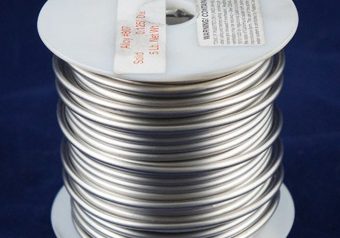
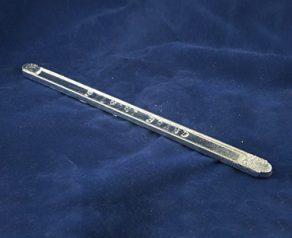
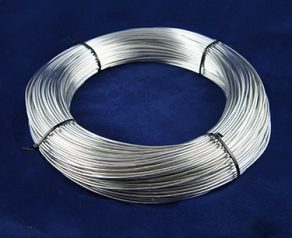
Wood’s Metal Low Melting Solder Wire is a bismuth-lead-tin-cadmium non-eutectic fusible alloy with a nominal composition of 50% Bi, 25% Pb, 12.5% Sn, and 12.5% Cd, supplied as solid wire in 1/4″ and 1/8″ diameters for low-temperature soldering and specialty applications. The solidus is 158F (70C) and the liquidus is 169F (76C), producing a very narrow 11F melting range that makes Wood’s Metal behave nearly like a eutectic. This low melting point allows soldering and joining operations at temperatures that would not damage wax, many plastics, wood, and other heat-sensitive substrates. Wood’s Metal is used for making metal inlays in wood furniture and art objects, for repairing antiques where the low melting temperature avoids damaging original materials, for making custom-shaped fusible elements, and as a low-temperature solder for applications where conventional solder temperatures are impractical. Forms: 1/4″ diameter and 1/8″ diameter solid wire.
Available Forms
1/4" Dia. Solid Wire, 1/8" Dia Solid Wire
Product Code
2502DS1C
Technical Info
Thermal Properties
Melting Point (Solidus)158°F (70°C)
Melting Point (Liquidus)169°F (76°C)
Physical Properties
Density (imperial)0.34 lbs/in³
Density (metric)9.41 g/cm³
Primary ElementsBi · Pb · Sn · Cd
Lead FreeNo — contains lead
Key Features
158F SolidusNarrow Melting RangeAntique and Wood Inlay ApplicationsLow-Temperature Solder
Nominal Composition
50% Bi
25% Pb
12.5% Cd
12.5% Sn
Frequently Asked Questions
Common technical inquiries regarding 158-169 Degree F Low Melting Alloy Wire
For wood inlay work, a channel or recess is routed into the wood surface to the desired design. The Wood's Metal wire is melted using a heat gun, hot water bath, or similar low-temperature heat source and poured or pressed into the channel. Because the alloy is fully liquid at 169F and well below the ignition temperature of wood, it fills the channel without charring the wood. After solidification, the proud surface is filed and sanded flush with the wood.
Wood's Metal is reserved for applications where the joining temperature must not exceed approximately 170-180F, below the melting point of most common solders. This includes joining thermoplastics and rubber components that cannot withstand higher temperatures and repairs to antique objects where heat-sensitive materials such as lacquers, veneers, and original patinas must be preserved. Cadmium content means Wood's Metal should not be used in food-contact or medical applications, and fume ventilation is required when melting.
The 50-25-12.5-12.5 Bi-Pb-Sn-Cd composition is designed to be close to the quaternary eutectic point of this alloy system, where the four components solidify simultaneously rather than sequentially. Near-eutectic compositions have very narrow melting ranges because all components reach their solubility limits at nearly the same temperature. This narrow range means the alloy freezes quickly and uniformly without the extended mushy zone that causes segregation and poor joint quality in alloys with wide melting ranges.
50% Sn / 50% Pb general purpose solder in regular bar and capping bar forms. Wide melting range. Used for automotive radiator, gutter repair, and electrical applications.
60% Sn / 40% Pb near-eutectic solder in bar form. Used for delicate electronics, precision soldering, and applications where narrow melting range is critical.