
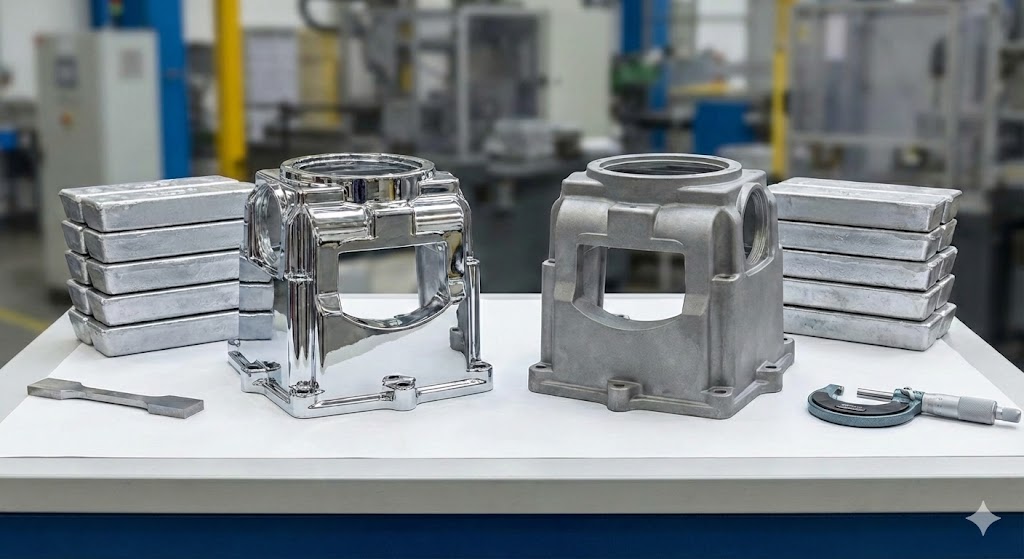
In the high-speed, high-volume world of zinc die casting, the “Zamak” family of alloys is the undisputed king. These zinc-aluminum-magnesium-copper alloys are legendary for their ability to be cast into complex, thin-walled shapes with incredible precision, excellent surface finish, and minimal tool wear. They are the backbone of industries ranging from automotive and electronics to hardware and toys.
However, a persistent issue we see at Belmont Metals is engineers specifying Zamak 3 and Zamak 5 interchangeably on their prints. While they share a base chemistry (roughly 4% Aluminum) and look identical to the naked eye, they have distinct mechanical personalities. Choosing the wrong one for your application can lead to expensive plating failures on the finishing line or unexpected part failures in the field.
Zamak 3: The Industry Standard for a Reason
Zamak 3 is the most widely used zinc die-casting alloy in North America, and it is the default choice for a good reason. Its defining characteristic is what it lacks: it contains effectively 0% Copper. This absence of copper gives Zamak 3 its primary advantages:
-
Superior Dimensional Stability: Copper is a restless element in zinc alloys; over time, it can cause very slight dimensional changes. Because it lacks copper, Zamak 3 offers excellent long-term dimensional stability. It will not “grow,” warp, or shift significantly over years of service, making it ideal for precision internal components.
-
The Plater’s Choice: Zamak 3 is the preferred alloy for parts that will require a decorative finish, whether it’s electroplating, painting, or chromating. Its surface structure is more uniform and accepts finishes more consistently than any other zinc alloy.
-
Best Applications: Automotive interior trim, bathroom fixtures, zippers, locks, and any hardware where aesthetics, fit, and finish are critical.
Zamak 5: The Stronger, Tougher Sibling
Zamak 5 is chemically identical to Zamak 3, with one major, intentional addition: roughly 1% Copper.
-
The Trade-Off: That single percent of copper significantly changes the alloy’s crystal lattice. It boosts tensile strength, hardness, and creep resistance. However, in metallurgy, there is almost always a trade-off. The gain in strength comes at the cost of reduced ductility (elongation). Zamak 5 is more brittle and harder to bend, crimp, or stake after casting compared to the more malleable Zamak 3.
-
Best Applications: Wheel balancing weights, structural brackets, gear housings, and functional components where raw strength and wear resistance are more important than formability or achieving a mirror-perfect plated finish.
The Belmont Guarantee: Purity is Non-Negotiable
Whether your project demands the ductility and finishing properties of No. 3 or the brute toughness of No. 5, the most critical factor is the purity of the starting ingot. Trace impurities like Lead, Cadmium, and Tin are poison to zinc alloys. They migrate to the grain boundaries and cause “intergranular corrosion,” a form of cancer that causes the casting to swell, crack, and eventually crumble like dust over time.
At Belmont Metals, our Zamak alloys are refined to exceed strict ASTM specifications, ensuring that your parts are not only strong today but will last as long as your reputation.
Need to verify your alloy choice? Before you cut steel for a new mold, send your part geometry and performance requirements to our metallurgical team. We are here to ensure you are casting with the right metal for the job.