
In the electroplating business, margins are tight and deadlines are tighter. There is nothing more frustrating than halting a high-volume production line because of “anode passivation”—the formation of a non-conductive film on the anode surface that stops the flow of current.
When plating slows down, voltage spikes, or deposits become uneven, the instinct is often to check the tank chemistry—the bath temperature, the pH, or the brightener levels. While these are critical variables, at Belmont Metals, we often find the culprit is the anode itself.
The Hidden Cost of “Cheap” Zinc
Zinc anodes function sacrificially to provide the metal ions that plate onto your parts. Ideally, they should dissolve at 100% efficiency. However, if the anode contains impurities—specifically Iron (Fe) or Lead (Pb)—these elements do not dissolve into the solution. Instead, they remain on the anode surface, forming a “sludge” or a black crust.
This sludge acts as an insulator. To maintain the plating rate (current density), your rectifiers have to work harder, consuming significantly more energy. Eventually, the anode “polarizes” completely, and plating stops. This downtime for tank cleaning and anode bagging is a silent profit killer.
The Belmont Solution: Purity is Paramount
The solution to sludge is simple: Purity. We manufacture our anodes from Special High Grade (SHG) Zinc, which is 99.99% pure. By strictly controlling iron and lead content, we ensure that the anode dissolves cleanly and evenly from start to finish.
-
Reduced Sludge: Less sludge means less frequent tank cleaning and longer life for your filter bags.
-
Energy Savings: A clean anode maintains a lower operating voltage, reducing your electricity bill.
-
Brighter Finishes: Impurities in the bath can cause dull or rough deposits. Starting with SHG Zinc ensures your brighteners work as intended.
Geometry Matters: Surface Area Management
The shape of the anode dictates the anode-to-cathode surface area ratio, a critical variable in electroplating. You cannot simply throw any piece of zinc into a basket and expect uniform results.
-
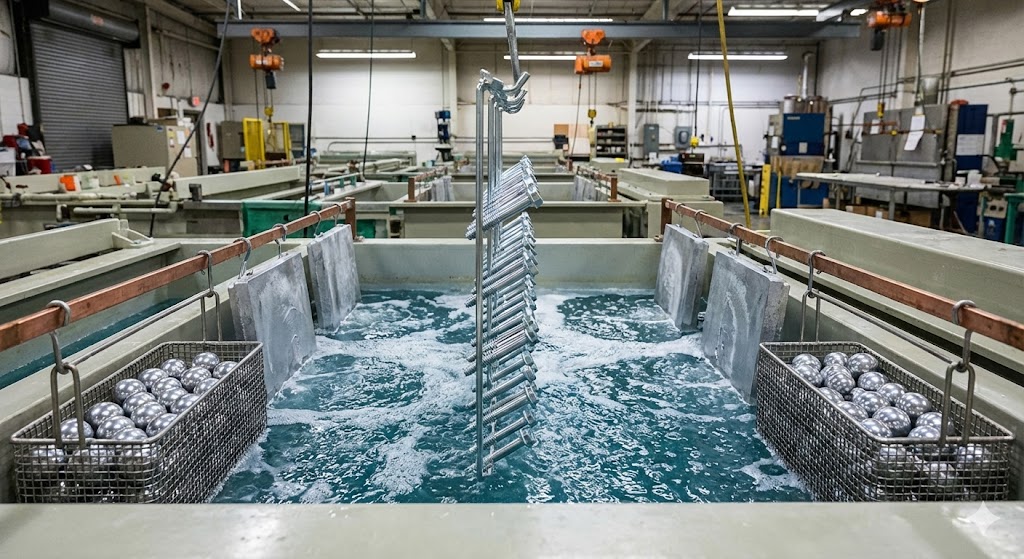
Zinc Balls (2”): These are the industry standard for titanium baskets. They provide the highest surface area per volume and are easy to “top up” without stopping the line. Because they settle naturally, they ensure constant electrical contact and eliminate the “bridging” issues seen with larger chunks.
-
Slabs and Ovals: For tank setups that use hanging hooks, our cast zinc slabs are designed to erode clearly. We engineer the cross-section to avoid “necking”—a common issue where an anode dissolves prematurely at the waterline, causing a heavy chunk of valuable zinc to break off and fall to the bottom of the tank.
Acid vs. Cyanide Baths
The type of bath you run dictates the type of anode you need.
-
Acid Chloride Baths: These are aggressive and require the highest purity SHG Zinc to prevent rapid impurity buildup.
-
Cyanide Baths: While less common today due to environmental regulations, they are still used for specific plating requirements. These baths often require a specific dissolution rate that can be managed with our controlled-purity anodes.
Whether you are plating automotive fasteners or decorative hardware, the consistency of your anode determines the consistency of your revenue. If you find yourself cleaning tanks more often than you are plating parts, it’s time to switch to a higher-purity Belmont Zinc Anode.