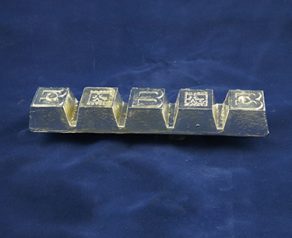
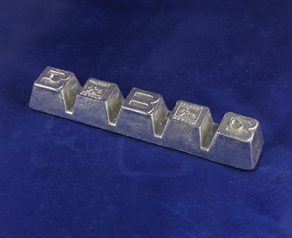
Micrograin Babbitt ASTM B-23 Grade 15 is a lead-base bearing alloy with a nominal composition of 1% Sn, 16% Sb, and balance Pb, conforming to ASTM B-23 Grade 15. Solidus is 479°F (248°C) and liquidus is 538°F (281°C), with a recommended pouring temperature of 662°F (350°C). The micrograin designation refers to the refined grain structure achieved through controlled cooling and antimony content, producing a more uniform dispersion of hard antimony-rich phases in the lead matrix than coarser-grained lead-base grades.
Grade 15 is specified for low-speed bearing applications where a refined microstructure improves wear uniformity and surface finish compared to standard lead-base grades. The very low tin content (1%) makes it the most economical of the ASTM B-23 grades in terms of tin content, while the high antimony content (16%) maintains adequate hardness for the intended low-speed service conditions.
Supplied in 5–8 lb ingots for conventional babbitting operations.
Common technical inquiries regarding Mircrograin Babbitt ASTM B-23 Grade 15
The micrograin designation indicates that Grade 15's microstructure contains finer, more uniformly distributed antimony-rich hard phases than standard lead-base grades, achieved through controlled pouring temperature, cooling rate, and alloy chemistry. At 16% Sb, the antimony content is at the high end for lead-base babbitts, and controlled solidification produces a finer dispersion of the hard SbSn and Sb-Pb intermetallic phases that provide wear resistance.
The near-absence of tin in Grade 15 means the alloy relies almost entirely on antimony for hardening, with less of the tin-antimony intermetallic SbSn phase present compared to Grades 7 or 8. This reduces corrosion resistance and high-temperature strength compared to higher-tin grades, making Grade 15 strictly a low-speed, moderate-temperature specification. The advantage is the lowest material cost of the lead-base ASTM B-23 grades.
Grade 15 is most commonly specified in agricultural equipment, slow-speed conveyor systems, textile machinery, woodworking equipment, and general industrial machinery where shaft speeds are low and the economics of lead-base babbitt are favorable. Regulatory restrictions on lead in machinery must be confirmed before specifying any lead-base babbitt.