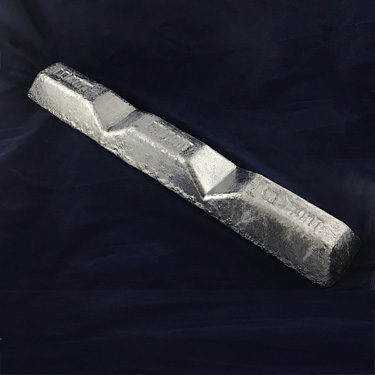
A444.2 is a specialized aluminum-silicon casting alloy with a nominal composition of 93% Al and 7% Si, formulated with very low iron content to maximize elongation and impact resistance. While standard 356-grade alloys accept iron levels up to 0.6%, A444.2 strictly controls iron to promote a microstructure that allows significant plastic deformation before fracture. Solidus is approximately 1,065°F (574°C) and liquidus approximately 1,135°F (613°C), with a density of 0.097 lbs/in³ (2.68 g/cm³).
This alloy is the premier choice for safety-critical structural castings subject to high shock loads — automotive steering knuckles, control arms, wheels, and structural brackets that must absorb impact energy without fracturing. Its superior weldability also makes it suitable for fabricated assemblies requiring post-casting welding. Where a standard 356-series alloy would crack under impact, A444.2’s exceptional elongation allows the casting to deform and survive.
Supplied in 3–16 lb ingots. The low iron specification requires careful attention to furnace cleanliness and scrap selection in the foundry to prevent iron contamination from tooling or returns.
Available Forms
3-16 Ingot
Technical Info
Thermal Properties
Melting Point (Solidus)1,065°F (574°C)
Melting Point (Liquidus)1,135°F (613°C)
Physical Properties
Density (imperial)0.097 lbs/in³
Density (metric)2.68 g/cm³
Primary ElementsAl · Si
Lead FreeYes
Key Features
High DuctilityExcellent Impact ResistanceLow IronSuperior Weldability
Nominal Composition
93% Al
7% Si
Frequently Asked Questions
Common technical inquiries regarding A444.2 Aluminum Alloy
Iron in aluminum-silicon alloys forms hard, brittle acicular (needle-shaped) intermetallic phases — primarily Al5FeSi — that act as stress concentrators and crack initiation sites under tensile or impact loading. By limiting iron to very low levels, A444.2 minimizes these brittle phases, allowing the softer aluminum matrix to dominate ductile behavior and producing elongation values of 12–20% versus the 3–6% typical of standard A356 in T6 condition.
Safety-critical automotive castings in A444.2 typically require radiographic inspection per ASTM E155 to verify freedom from internal porosity and shrinkage, tensile coupon testing from each heat or lot to confirm elongation meets specification, and often dye-penetrant or fluorescent penetrant inspection of the casting surface. The low iron requirement should also be verified by spectrographic analysis of each heat to confirm compliance.
A444.2 welds readily using GTAW (TIG) or GMAW (MIG) with 4043 or 4047 filler wire, producing joints with good strength and ductility. A380.2 and 319-series alloys have higher copper content that promotes hot cracking in the heat-affected zone during welding, making them poorly weldable. Post-casting welding is important for A444.2 in structural assemblies where repair welding of minor defects is required and where welded subassembly joints must maintain crash-energy-absorption performance.
To provide the best experiences, we use technologies like cookies to store and/or access device information. Consenting to these technologies will allow us to process data such as browsing behavior or unique IDs on this site. Not consenting or withdrawing consent, may adversely affect certain features and functions.
Functional
Always active
The technical storage or access is strictly necessary for the legitimate purpose of enabling the use of a specific service explicitly requested by the subscriber or user, or for the sole purpose of carrying out the transmission of a communication over an electronic communications network.
Preferences
The technical storage or access is necessary for the legitimate purpose of storing preferences that are not requested by the subscriber or user.
Statistics
The technical storage or access that is used exclusively for statistical purposes.The technical storage or access that is used exclusively for anonymous statistical purposes. Without a subpoena, voluntary compliance on the part of your Internet Service Provider, or additional records from a third party, information stored or retrieved for this purpose alone cannot usually be used to identify you.
Marketing
The technical storage or access is required to create user profiles to send advertising, or to track the user on a website or across several websites for similar marketing purposes.