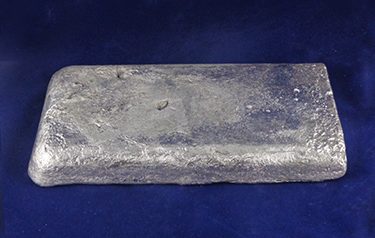
20% Nickel Aluminum is a master alloy with a nominal composition of 80% Al and 20% Ni, designed to improve the high-temperature mechanical properties of aluminum casting alloys. Nickel forms thermally stable Al3Ni and Al-Cu-Ni intermetallic compounds that resist coarsening at elevated temperatures, maintaining strength and hardness well above the service temperatures at which standard aluminum alloys soften. Dissolution is good in molten aluminum at 1,400°F and above.
This master alloy is extensively used in the production of pistons, cylinder heads, and other automotive powertrain components where the alloy must retain strength and hardness through repeated thermal cycling at elevated service temperatures. Nickel additions also lower the coefficient of thermal expansion, improving dimensional stability in precision parts operating across a wide temperature range. It is a key hardener in 2xx-series aluminum-copper alloys designed for elevated-temperature service.
Supplied in 1″ x 6″ x 12″ slab form, providing a larger surface area for rapid dissolution compared to using pure nickel pellets or briquettes, which dissolve slowly and inconsistently in aluminum melts.
Good dissolution in molten aluminum at 1,400°F and above; thorough stirring after addition improves recovery.
Nominal Composition
80% Al
20% Ni
Frequently Asked Questions
Common technical inquiries regarding 20% Nickel Aluminum
Nickel additions of 0.8–2.5% in aluminum piston alloys produce a measurable increase in elevated-temperature hardness and creep resistance through the formation of stable Al3Ni and Al-Cu-Ni intermetallics. Below 0.8%, the effect is marginal; above 2.5%, the increasing volume fraction of intermetallics can reduce room-temperature ductility. Most commercial piston alloys such as A332 and A336 target 0.8–1.3% Ni as the optimum balance between high-temperature performance and ambient ductility.
Nickel intermetallics have a significantly lower coefficient of thermal expansion (CTE) than the aluminum matrix, and their presence as a dispersed second phase reduces the bulk CTE of the alloy in proportion to their volume fraction. For piston applications, a lower CTE reduces the change in piston-to-bore clearance between cold start and operating temperature, improving sealing, reducing blow-by, and extending ring and bore life — the same benefit that hypereutectic Al-Si alloys provide but through a different metallurgical mechanism.
Pure nickel has a melting point of 2,651°F — nearly four times the temperature of an aluminum melt — making direct dissolution extremely slow regardless of form. However, the Al-Ni master alloy's slab geometry maximizes surface area contact with the melt, and the pre-alloyed aluminum matrix melts readily at 1,525°F, releasing nickel in a dispersed, reactive form that dissolves far more quickly and completely than pellets or briquettes. Consistent slab dimensions also allow accurate charge weight calculation.
Al-Be master alloy (97.5% Al, 2.5% Be) for oxidation control and dross reduction in aluminum and magnesium casting melts. 4-5 oz pieces and 5 lb slabs.
Concentrated Al-Be master alloy (95% Al, 5% Be) for oxidation control in large-scale aluminum and magnesium casting. Higher potency than 2.5% grade. 4-5 oz pieces and 5 lb slabs.
Al-Si master alloy (50% Al, 50% Si) for precise silicon additions to improve fluidity and reduce shrinkage in aluminum casting alloys. Waffle and granular forms.
To provide the best experiences, we use technologies like cookies to store and/or access device information. Consenting to these technologies will allow us to process data such as browsing behavior or unique IDs on this site. Not consenting or withdrawing consent, may adversely affect certain features and functions.
Functional
Always active
The technical storage or access is strictly necessary for the legitimate purpose of enabling the use of a specific service explicitly requested by the subscriber or user, or for the sole purpose of carrying out the transmission of a communication over an electronic communications network.
Preferences
The technical storage or access is necessary for the legitimate purpose of storing preferences that are not requested by the subscriber or user.
Statistics
The technical storage or access that is used exclusively for statistical purposes.The technical storage or access that is used exclusively for anonymous statistical purposes. Without a subpoena, voluntary compliance on the part of your Internet Service Provider, or additional records from a third party, information stored or retrieved for this purpose alone cannot usually be used to identify you.
Marketing
The technical storage or access is required to create user profiles to send advertising, or to track the user on a website or across several websites for similar marketing purposes.