
Product Code: 1859

384.1 Aluminum Alloy

Lead-freeAA 384.1 Excellent Fluidity Fills Thin, Complex Sections Good Strength and Hardness Hot Crack Resistance
Aluminum die casting alloy (11.25% Si, 3.75% Cu) with excellent fluidity for thin-walled, intricate die castings.
Solidus
960°F (516°C)
Liquidus
1,080°F (582°C)
Density
0.099 lbs/in³ (2.74 g/cm³)
Primary Elements
Al, Cu, Si
Nominal Composition
0.1% Mg, 0.35% Sn, 0.5% Mn, 0.5% Ni, 1.0% Fe, 11.25% Si, 2.9% Zn, 3.75% Cu, Bal. Al
Custom request

Can't find the right composition?

Product Overview

384.1 Aluminum Alloy is an aluminum-silicon-copper die casting alloy with a nominal composition of 11.25% Si and 3.75% Cu, with zinc, iron, and other controlled elements. The “.1” designation identifies it as an ingot grade for remelting. It has a melting range of roughly 960–1,080°F (516–582°C).

The higher silicon content gives 384 better fluidity and die-filling ability than 380, making it well suited to thin-walled, complex castings that are difficult to fill. Copper provides good strength and hardness, and the alloy has good resistance to hot cracking. It is used for automotive components, housings, and other intricate die castings.

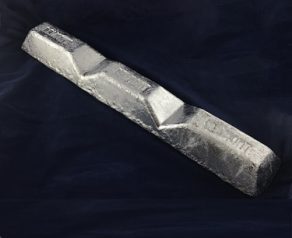
Supplied as 3-16 ingot.
Available Forms

3-16 Ingot

Product Code

1859

Technical Info

Thermal Properties

Melting Point (Solidus)960°F (516°C)
Melting Point (Liquidus)1,080°F (582°C)

Physical Properties

Density (imperial)0.099 lbs/in³
Density (metric)2.74 g/cm³
Primary ElementsAl, Cu, Si
SpecificationAA 384.1
Lead FreeYes
Key Features
Excellent FluidityFills Thin, Complex SectionsGood Strength and HardnessHot Crack Resistance
Solubility Note

its lower melting range than 380 allows slightly lower holding temperatures., Melts readily in standard aluminum furnaces

Nominal Composition

  • 11.25% Si
  • 3.75% Cu
  • 2.9% Zn
  • 1.0% Fe
  • 0.5% Mn
  • 0.5% Ni
  • 0.35% Sn
  • 0.1% Mg
  • Bal. Al
384 contains more silicon than 380, which improves fluidity and makes it easier to fill thin, intricate die cavities. 380 offers somewhat better ductility and is the more common general-purpose alloy. Choose 384 when castability in complex, thin-walled parts is the priority.
Its copper content gives it moderate corrosion resistance, similar to 380. For parts exposed to marine or wet environments, a low-copper alloy such as 360 is a better choice.
Typical uses are automotive and transmission components, engine brackets, housings, and thin-walled, intricate die castings that are difficult to fill with 380.

Safety Data (SDS)

Request a Quote

Complete our Quote form, and we'll respond with options for you!