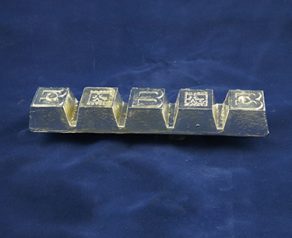
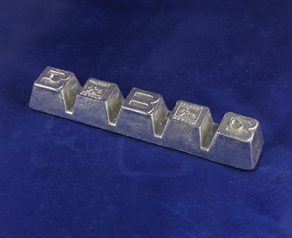
#4 Babbitt Alloy is a lead-antimony bearing alloy with a nominal composition of 90% Pb and 10% Sb. The simple binary lead-antimony composition provides the low friction and conformability characteristics of babbitt bearing materials at the lowest cost point in the product range, with antimony additions providing hardening of the lead matrix sufficient for low-speed, low-load service conditions.
This alloy is used in low-speed, lightly loaded anti-friction bearing applications in industrial equipment, agricultural machinery, and general manufacturing where the service conditions do not justify the cost of tin-containing or copper-bearing grades. The absence of tin and copper makes it the most economical babbitt option, suited to applications where bearing replacement is frequent and material cost is the primary consideration.
Supplied in 5–8 lb ingots for conventional babbitting operations and in 50 lb pigs for bulk supply to operations consuming large quantities of lead-base bearing material.
Available Forms
5-8 Ingot, 50 Lb. Pigs
Product Code
5906
Technical Info
Thermal Properties
Melting Point (Solidus)486°F (252°C)
Melting Point (Liquidus)563°F (295°C)
Physical Properties
Density (imperial)0.385 lbs/in³
Density (metric)10.66 g/cm³
Primary ElementsPb · Sb
Lead FreeNo — contains lead
Key Features
Low-Cost Bearing GradeLead-Antimony BaseLow-Speed ApplicationBulk Supply Available
Nominal Composition
10 Sb
90 Pb
Frequently Asked Questions
Common technical inquiries regarding #4 Babbitt Alloy
The absence of tin in #4 Babbitt means it lacks the SbSn intermetallic hardening phases that give tin-containing grades their superior hardness, corrosion resistance, and high-temperature strength. #4 is limited to low speeds — typically below 500 RPM — and light to moderate loads where the lead matrix can conform to the shaft without excessive plastic deformation. For any application involving moderate speed, heavy load, or acidic operating environments, a tin-containing ASTM B-23 grade should be specified instead.
The 50 lb pig format serves operations that consume large quantities of lead-base babbitt — such as high-volume bearing rebabbitting shops and industrial facilities with ongoing bearing maintenance programs. The larger pig size reduces the number of individual pieces to be handled and charged per heat, improving efficiency in high-throughput operations. Ingots remain the preferred form for smaller heats where accurate charge calculation and manageable piece weight are priorities.
Yes. Lead-containing alloys are subject to increasing regulatory restrictions including RoHS in electrical and electronic equipment, REACH regulations in Europe, and various national occupational exposure limits for lead dust and fume during machining and pouring operations. For new equipment designs, engineers should confirm whether lead-containing materials are permitted in the intended market and application category. Where restrictions apply, tin-base babbitts (ASTM B-23 Grades 1, 2, 3, 11) or lead-free bearing alternatives should be specified.
To provide the best experiences, we use technologies like cookies to store and/or access device information. Consenting to these technologies will allow us to process data such as browsing behavior or unique IDs on this site. Not consenting or withdrawing consent, may adversely affect certain features and functions.
Functional
Always active
The technical storage or access is strictly necessary for the legitimate purpose of enabling the use of a specific service explicitly requested by the subscriber or user, or for the sole purpose of carrying out the transmission of a communication over an electronic communications network.
Preferences
The technical storage or access is necessary for the legitimate purpose of storing preferences that are not requested by the subscriber or user.
Statistics
The technical storage or access that is used exclusively for statistical purposes.The technical storage or access that is used exclusively for anonymous statistical purposes. Without a subpoena, voluntary compliance on the part of your Internet Service Provider, or additional records from a third party, information stored or retrieved for this purpose alone cannot usually be used to identify you.
Marketing
The technical storage or access is required to create user profiles to send advertising, or to track the user on a website or across several websites for similar marketing purposes.