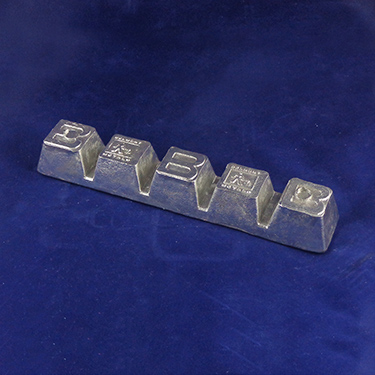
Heavy Duty Babbitt ASTM B-23 Grade 3 is a tin-base bearing alloy with a nominal composition of 84% Sn, 8% Sb, and 8% Cu, conforming to ASTM B-23 Grade 3. Solidus is 464°F (240°C) and liquidus is 792°F (422°C), with a recommended pouring temperature of 915°F (490°C). The high combined antimony and copper content produces the hardest and strongest of the standard tin-base ASTM B-23 grades, with a large volume fraction of Cu6Sn5 and SbSn intermetallic phases providing exceptional load-carrying capacity.
Grade 3 is the heavy-duty specification for the most demanding tin-base babbitt applications, including large rolling mill bearings, heavy-duty marine diesel engine bearings, high-load compressor bearings, and industrial machinery subject to shock loading. Where Grade 1 and Grade 2 are specified for high-speed applications, Grade 3’s greater hardness and compressive strength make it the correct choice when load intensity is the primary design constraint.
Forms: 5–6 lb ingots for furnace pouring of large bearing surfaces and in 1/4″ and 1/8″ solid wire for torch-applied bearing repair and small precision bearing applications.
Common technical inquiries regarding Heavy Duty Babbitt ASTM B-23 Grade 3
Grade 3's liquidus of 792°F (422°C) is the highest of the standard tin-base grades due to its elevated copper content, which raises the liquidus temperature by forming refractory Cu6Sn5 intermetallic phases that must be fully dissolved before pouring. The recommended pouring temperature of 915°F (490°C) provides adequate superheat above the liquidus to ensure complete fluidity and fill before premature solidification occurs. Pouring below 900°F risks incomplete fill and cold shuts in complex bearing geometries.
Grade 3's hardness advantage is realized in high-load, low-to-medium-speed applications — rolling mill roll necks, large reciprocating compressor crosshead bearings, and heavy-duty marine applications are typical examples. However, in high-speed, lightly loaded applications, Grade 3's lower conformability and reduced embeddability can cause accelerated shaft wear if the bearing surface cannot accommodate minor geometric imperfections or hard particle contaminants in the lubricant.
For torch-applied wire babbitting, the bearing shell should be cleaned, tinned with a flux, and preheated to approximately 300–350°F before wire application. The torch should be adjusted to maintain the wire at a molten state without overheating the deposited metal, which causes tin oxidation and porosity. Apply in thin, overlapping passes building up to final thickness, and allow natural cooling rather than quenching to prevent thermal stress cracking.