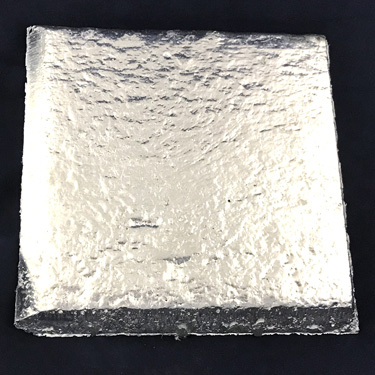
Al-Be master alloy (97.5% Al, 2.5% Be) for oxidation control and dross reduction in aluminum and magnesium casting melts. 4-5 oz pieces and 5 lb slabs.
2.5% Beryllium Aluminum is a master alloy with a nominal composition of 97.5% Al and 2.5% Be, designed to control oxidation and reduce melt loss in magnesium-bearing aluminum alloys. Solidus is approximately 1,190°F (643°C) and liquidus approximately 1,250°F (677°C), with a density of 0.097 lbs/in³ (2.69 g/cm³). Acting as a powerful getter, beryllium forms a tight, adherent protective oxide film on the melt surface that significantly suppresses dross formation and magnesium burnout. Dissolution is rapid in molten aluminum and magnesium alloys at 1,300°F and above.
This alloy is widely used in the production of 5xxx and 7xxx series aluminum alloys where magnesium content makes the melt highly susceptible to oxidation. Even at very low addition levels — typically 0.001–0.005% Be in the finished alloy — it substantially improves metal cleanliness, reduces inclusion content, and improves the consistency of mechanical properties by minimizing oxide bifilms in the casting. It is essential in foundries casting high-magnesium alloys such as 520 and 535.
Forms: 4–5 oz pieces and 5 lb slabs for accurate dosing across a range of furnace heat sizes.
Rapid dissolution in molten aluminum and magnesium alloys at 1,300°F and above.
Nominal Composition
94.75% Al
5.25% Be
Frequently Asked Questions
Common technical inquiries regarding 2.5% Beryllium Aluminum
Effective oxidation control in magnesium-bearing aluminum alloys is achieved at beryllium levels of 0.001–0.005% in the finished melt. For the 2.5% master alloy, this translates to an addition rate of approximately 0.04–0.20 lbs per 100 lbs of melt charge. The 4–5 oz piece size is specifically designed to allow accurate additions at these low levels without overalloying, which can cause issues in certain alloy systems.
Magnesium has a very high affinity for oxygen and forms a loose, non-protective oxide (MgO) at melt temperatures that continuously exposes fresh metal to further oxidation. Beryllium additions form a thin, dense BeO or mixed Be-Mg oxide film that is far more adherent and protective than MgO alone, effectively sealing the melt surface against further oxygen ingress. This dramatically reduces dross generation and the associated magnesium burnout losses that increase alloy chemistry variability.
Beryllium is a known carcinogen and sensitizer — chronic beryllium disease (CBD) can result from inhalation of beryllium-containing dust or fumes at very low concentrations. When handling solid beryllium-aluminum master alloys, the primary risk is during cutting, breaking, or any operation that generates dust or fume. Foundries should follow OSHA beryllium standard requirements (29 CFR 1910.1024), including engineering controls, respiratory protection when airborne beryllium is present, and medical surveillance for exposed workers.
Concentrated Al-Be master alloy (95% Al, 5% Be) for oxidation control in large-scale aluminum and magnesium casting. Higher potency than 2.5% grade. 4-5 oz pieces and 5 lb slabs.
Al-Si master alloy (50% Al, 50% Si) for precise silicon additions to improve fluidity and reduce shrinkage in aluminum casting alloys. Waffle and granular forms.
To provide the best experiences, we use technologies like cookies to store and/or access device information. Consenting to these technologies will allow us to process data such as browsing behavior or unique IDs on this site. Not consenting or withdrawing consent, may adversely affect certain features and functions.
Functional
Always active
The technical storage or access is strictly necessary for the legitimate purpose of enabling the use of a specific service explicitly requested by the subscriber or user, or for the sole purpose of carrying out the transmission of a communication over an electronic communications network.
Preferences
The technical storage or access is necessary for the legitimate purpose of storing preferences that are not requested by the subscriber or user.
Statistics
The technical storage or access that is used exclusively for statistical purposes.The technical storage or access that is used exclusively for anonymous statistical purposes. Without a subpoena, voluntary compliance on the part of your Internet Service Provider, or additional records from a third party, information stored or retrieved for this purpose alone cannot usually be used to identify you.
Marketing
The technical storage or access is required to create user profiles to send advertising, or to track the user on a website or across several websites for similar marketing purposes.